My wife’s grandmother left us a wool Persian rug, and I did the worst possible thing to it: I rented a steam cleaner and went to town on a Saturday afternoon. By Sunday, the reds had bled into the cream border. That mistake cost us four hundred dollars and a month of waiting on a specialty shop. So here’s the deal, because I want you to skip my mistake entirely.
You can clean an oriental rug at home all year long, as long as you stick to surface care: vacuuming, beating, and spot treatment. Deep cleaning a hand-knotted or antique piece is a different job, and it belongs with someone who can read fiber and dye before they touch water. Understanding the difference takes a few minutes and it saves you thousands. Plenty of homeowners skip straight to the machine anyway, and you can probably guess how that ends.
The core problem is that a rug has layers of soil you can’t see. Dry dust and grit work down into the base of the pile, and every footstep grinds those particles against the fibers like sandpaper. If you want a genuinely cleaner rug, real cleaning starts with pulling that dry soil out before any liquid comes near it. Water plus grit equals felted wool, and felted wool never comes back.
That’s the whole ballgame. Everything below is how you apply it.
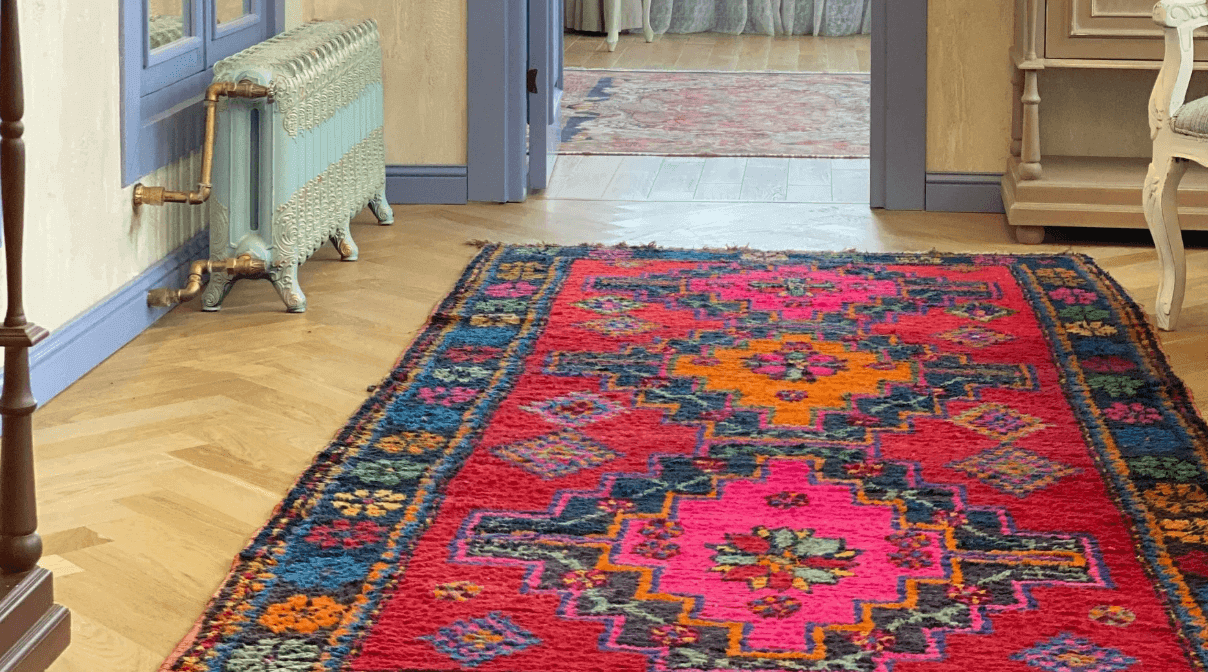
First, figure out what you’re actually standing on
Not every rug in your house plays by the same rules, and the rug you bought at a big box store has almost nothing in common with a wool Kerman your aunt carted home from a trip. Before you buy a single bottle of anything, spend ten minutes on identification.
- Hand-knotted wool or silk. Investment grade. Treat it like furniture, not flooring.
- Machine-made wool or viscose. Tougher, but viscose is the wild card. It looks like silk and behaves like wet paper.
- Flat-weaves and kilims. No pile, so dust has nowhere to hide, but the weave is often looser and more prone to distortion.
- Natural fiber (jute, sisal, seagrass). Never soak these. You’ll get rot and a smell you can’t undo.
Flip a corner and look at the back. Hand-knotted rugs show individual knots and an uneven, slightly wobbly line where the weave ends. Machine-made rugs show a perfectly straight grid and a glued, uniform backing. That single look tells you whether you’re dealing with a piece worth four figures or one worth replacing.
Here’s my stance, and it’s not popular: if a rug in your room costs you more than a decent laptop, don’t wet-clean it yourself. Surface maintenance, yes. Full immersion, no. The risk-to-reward math just doesn’t work.
How to Clean an Oriental Rug Between Professional Washes: Your Weekly Routine
The best thing you can do for any rug is boring and takes fifteen minutes a week. Think of it as brushing your teeth. No single session matters much, but skipping a year of them absolutely does.
Vacuum with suction, not with a beater bar running at full aggression. If your vacuum has a height adjustment, raise it so the brush barely kisses the surface on a wool rug and turn the brush roll off entirely on anything antique or fringed. Run the wand over the rug in slow, overlapping passes going one direction, then come back across it perpendicular. That cross pattern lifts more embedded grit than a dozen quick swipes in one line.
Every few weeks, take the rug outside on a dry day, lay it over a railing, and beat it with a broom handle from the back side. You will be genuinely shocked at the dust cloud. This is the single highest-value thing a homeowner can do without spending a dime, and it’s the step everyone skips.
Rotate the rug twice a year. Sun and foot traffic both fade and wear one section faster than the rest, and a quarter turn evens out twenty years of damage into something approaching uniform.
How to Spot Clean an Oriental Rug: The Six-Step Triage
Spills are where good rugs die, mostly because people panic and scrub. Scrubbing grinds the stain deeper into the fiber and roughs up the surface permanently. Work this sequence instead, and stop the moment the stain lifts.
- Blot, don’t rub. Clean white towels, press down, lift. Swap towels as they load up.
- Lift solids first. Scrape gently with a spoon or a dull butter knife, working from the outside of the spill inward.
- Test your solution somewhere hidden. A corner on the back is ideal. Wait ten minutes and check for color transfer onto your white towel.
- Use the mildest thing that works. A drop of dish soap in a cup of cool water handles most food and drink spills.
- Rinse with plain water and blot dry. Soap residue attracts dirt, so a rinse is mandatory, not optional.
- Weight it and let air move under it. Stack books on a clean towel, prop the rug up, and give it a full day.
Skip vinegar on wool and silk. Skip anything with bleach, oxygen boosters, or enzymes unless you know exactly what your fiber is. And never, ever use hot water on a dye that hasn’t been tested.
Fringe deserves its own warning, because it’s the part of the rug a well-meaning cleaning ruins most easily. Those loose ends are the rug’s foundation, and soaking them can pull dye from the border right onto them. Vacuum fringe with the brush roll off and the suction attachment only. If it looks gray, test one strand with a white cloth dampened in cool water and a drop of dish soap, then dab, rinse with a clean damp cloth, and blot dry. If the fringe is fraying or the knots feel loose, that goes in the professional pile, not the DIY one.
One more thing worth knowing: the volatile organic compounds in household cleaning products can hang around indoors long after the bottle is capped, which is why the Environmental Protection Agency keeps a whole body of guidance on indoor air quality. Rugs are porous and they hold onto whatever you put in them. Ventilate the room while you work.
When to Call a Professional Oriental Rug Cleaner
Some jobs are above your pay grade and pretending otherwise is expensive. Call someone when any of these are true.
- The rug is antique, hand-knotted, silk, or has sentimental value you can’t replace.
- You’re looking at pet urine, red wine, ink, or anything that’s been sitting more than a day.
- There’s a smell coming from the rug itself, not the surface.
- The fringe is fraying or the foundation feels loose.
- You’ve already tried once and made it worse.
Professional cleaners work in steps you simply can’t replicate at home: a dye fastness test that takes hours, dry soil extraction with commercial equipment, controlled washing, and a drying setup that prevents the mildew and shrinkage that follow a wet rug left to air out in a garage. Manufacturer guidance generally points to professional cleaning every two to four years on fine rugs, with the interval tightening in high-traffic homes.
There’s a preservation angle here too, and it’s the reason museums treat textiles the way they do. According to the National Park Service, which manages historic furnishings in its collections, textiles are damaged most by light, moisture, and improper handling, which is the same trio that quietly destroys rugs in living rooms. Same enemy, smaller scale.
The four-quadrant call
Here’s the framework I use, and it’s saved me from at least two expensive errors. I call it the four-quadrant call.
| Rug value | Stain or wear level | What to do |
| Low (under $300) | Minor | DIY spot treatment. No hesitation. |
| Low | Heavy, smells | Replace it. Cleaning costs more than the rug. |
| High (heirloom, hand-knotted) | Minor | DIY surface care only. Never wet-clean. |
| High | Heavy or urgent | Professional, immediately. Don’t wait a week. |
I’d rather spend two hundred dollars on the right cleaning than two hundred replacing a rug I loved. Nine times out of ten, the pro route wins on anything you’d describe to a guest.
What good care actually looks like
Cleaning an oriental rug well comes down to a few unglamorous habits. Vacuum slowly. Beat the rug outside twice a season. Rotate it every six months. Test every liquid in a hidden corner before it touches the face. Blot instead of scrubbing, and know when to put the phone down and call someone.
A wool rug with a proper base under it will hold up through decades of daily life if you give it those small mercies. Skip them and you’ll be replacing something you can’t replace. Which of your rugs is overdue for a vacuum right now?