Adding a new garage door can transform your property, but working out the new garage door cost for your home is not straightforward.
On the surface, many new garage doors appear similar, yet they may vary substantially in price based on panel composition, overall dimensions, and additional elements the professional will need to remove/install.
Knowing these factors ahead of time will help inform you of the price differences to expect from the various decisions you can make, before soliciting quotes from companies in your area.
Key Takeaways
- Base New Garage Door Cost
- Garage Door Material
- Garage Door Dimensions and Features
- Additional Installation Considerations
- How to compare new garage door quotes
- Conclusion
Base New Garage Door Cost
More importantly, you need to establish what a quoted price represents.
Is the price solely for the garage door, or does it include ancillary components such as the track, springs, garage door motor, tear-out, etc.? If it’s for a garage door replacement, these components may or may not be included in the price, depending on the company. You want to clarify what’s included before you draw conclusions about which company is providing a more competitive price.
If you’re provided a rough quote without knowledge of your garage door opening, there may be additional costs discovered that require remediation of the surrounding area, or to install additional components to allow your old motor (if present) to interface with the new door, among others.
According to Zonda’s 2025 Cost vs Value report, the cost of their model project to install a new garage door was $4,672 nationwide, with an insulated 16′ x 7′ steel garage door, replacement track, and existing powered garage door motor left in place. Use this as a guideline, but be sure to obtain quotes in your area to confirm the price, or use the A1 garage door cost guide to learn more about the variables that may impact the cost of your new garage door.
Most homeowners pay somewhere between $1,151 and $1,869 for a standard installation, with about $1,400 as the average, according to This Old House. HomeAdvisor reports a much wider range of $400 to $10,000, with an average of $1,500. The gap between these figures and the Zonda example above comes down to the door’s size, insulation and what the quote includes, which is why it pays to compare like for like.
By knowing what to expect, you can direct questions to a company servicing your region and ask them what’s included in their price, or what else may need to be added to your quote.
Garage Door Material and How It Affects Cost
Aside from influencing the cost, the material chosen will dictate the heft, aesthetics, and required maintenance of the new garage door.
A steel garage door is a common option, available in a variety of configurations, both with and without insulation. Unless you require a very ornate, decorative garage door, steel will likely provide an affordable solution to suit your property, subject to the level of detail, quality of panel, coating, etc.
A wooden garage door provides greater character to your property, but tends to command a premium, and may require maintenance, e.g. painting, as the element degrades over time. Factor in the future cost of upkeep if you choose to go with a wood garage door.
You can also choose an aluminium and/or glass garage door, which lends to a contemporary feel, with the aluminium being light and durable, but the amount of glass may affect insulation/privacy, and price, depending on the complexity of the door.
Alternatively, composite, faux-wood, etc. garage doors combine multiple materials, allowing you to achieve certain aesthetic effects without having to fully commit to, say, a wooden garage door. Ensure you review the build, warranty, and care instructions if you opt for such a product.
As a rough guide, Yelp’s quote data puts aluminium, vinyl, fibreglass and steel doors at about $500 to $3,500 installed, while wood, wood composite and glass doors run from about $800 to $5,000 or more. Treat these as ranges rather than prices, as your location, size and finish will move the figure.
Do I need an insulated garage door?
You may wish to insulate your new garage door, particularly if it abuts your living space, is frequently used, or is particularly hot/cold, subject to climate. Be careful, however, as a door panel’s advertised R-value does not measure the thermal performance of the complete door, so look to find a U-Factor, which will take into account the overall thermal transmittance of the door, with a lower value equating to higher efficiency.
Garage Door Size and Features That Affect the Price
Larger new garage doors will naturally require more material, increasing the cost, but there may be other factors, such as requiring longer/different tracks, etc., which can also factor into the price.
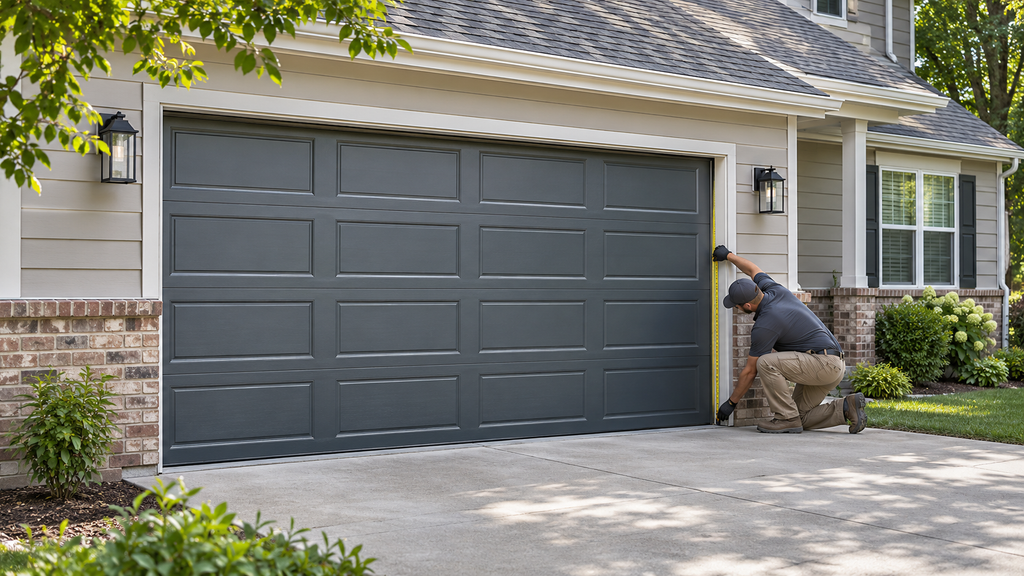
Measure your intended width and height, and allow a qualified professional to survey your space, including the ceiling, lateral, and internal clearances to ensure adequate space for operation of the new garage door.
Should you have a double-width garage, you may prefer one large garage door, or two smaller, and again, you need to factor in the associated cost of this, e.g. number of garage doors, motor, tracks, etc. to establish which may be the most cost-effective option, if at all, and what features you’d want to have on your garage doors.
Depending on the new garage door, there may be additional costs to consider, including, but not limited to, windows, handles, pattern, colour, faux wood, insulation, additional weatherstripping, and/or custom sizing, among others.
Establish which features you’d want, and be sure not to be overly influenced by the show-room door you may be looking at.
Additional Installation Considerations
A trained professional should be employed to correctly install your new garage door, to fit the appropriate springs, tracks, and, if applicable, motor to suit your new door, and to complete final checks.
Labour is usually the smaller part of the bill. Angi puts the average cost of fitting a door at about $350, within a range of $200 to $500, and adding an opener can add roughly $200 to $1,300 on top. Ask each company whether the old door’s removal and disposal are included in the labour figure or charged separately.
If you have an existing garage door, it’s possible that the tracks, etc. may no longer be suitable for the new, and you may need to procure a new set, and, if you have a garage door motor, determine whether it’s compatible with the new garage door, or if you need to buy a new one, and factor this into the cost.
Due to the tension placed on the springs, the DASMA recommends employing qualified professionals, as incorrect adjustment/replacement can result in injury, so don’t attempt to cut costs here.
Confirm whether removal, disposal, hardware, opener work, permits and final safety checks are included. In storm-prone areas, ask about locally appropriate wind-rated doors, as IBHS advises.
How to compare new garage door quotes
Now you know some of the considerations to keep in mind, you should have a good understanding of what’s involved, and how to gauge the relative merits of any quotes received.
Arm your shortlist with your preferences, i.e. dimensions, material, insulation, aesthetics, and whether to evaluate the current motor, and ask each company to provide you with an itemised, written quote, then scrutinise each of them to confirm:
- Details of the specified garage door, i.e. size, material, insulation, windows, etc.;
- Components/installation to be undertaken;
- Whether any additional costs may be incurred, and why, upon further evaluation of your property, e.g. track, motor, remedial work, etc.; and
- Details of the warranty, including period, exclusions, etc.
Once you’ve eliminated those with omissions, you can weigh up the merits, taking into account your usage, i.e. if it’s purely to store your vehicle, a more economical, non-insulated, door may suffice, whereas, if you require more, you may need to spend a little more, accordingly, to achieve the best result, whether it’s insulation, durability, noise, etc.
Conclusion
You now know some of the main considerations that may impact the cost of your new garage door, including, but not limited to, material, dimensions, and installation, and, depending on the style, you may have to factor in the cost of add-ons, and, if you live in a hurricane zone, a suitable, higher-rated, wind-resistant garage door, etc.
Having established your preferences, you should be in a position to receive a competitive, comprehensive, quote, and, hopefully, enjoy your new, improved, garage door.