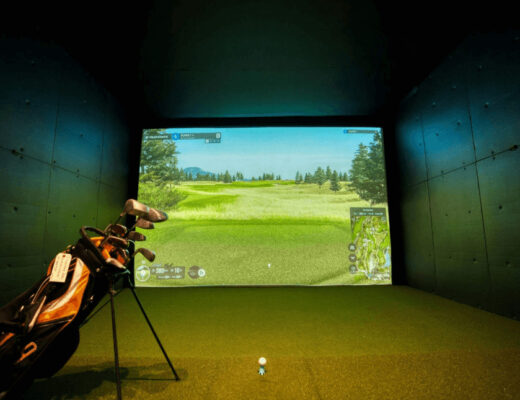
Most garages and spare rooms weren’t built with a full driver swing in mind. Ceilings sit around 8 or 9 feet, a car or workbench takes half the floor, and the wrong enclosure can leave you choking up on every club or patching drywall after a shank. The right one fits the room you actually have. Below are eight enclosures that suit home garages and small spaces, plus how to measure before you buy.

Why Small-Space Enclosures Have Gotten So Much Better
“Home simulators” used to mean a heavy steel frame that took over a room permanently. That has changed fast, mostly because demand has. More golfers than ever now play away from the course, at ranges, entertainment venues and indoor simulators, and a growing share of them want that setup at home.
Manufacturers have responded with shallower frames, tool-free assembly and retractable designs that roll up when the space needs to be a garage again. A single-car bay or a basement with a 9-foot ceiling is now a realistic place for a simulator, as long as you choose an enclosure built for those limits.
| Enclosure | Type | Footprint / Sizes | Best For | Starting Price* |
| GolfBays SimBox | Fixed, folding frame | 7 sizes, from 8’6″ W x 8’2″ H x 4’11” D | Flexible garage setups | ~$1,700 |
| SportScreen Vanish | Retractable, wall/ceiling mounted | 5 widths, custom up to 16′ | Multi-use rooms | ~$3,000 |
| Carl’s Place DIY | Fixed, DIY pipe frame | 6 sizes from 8×8 to 9×12, 5′ deep | Odd-shaped rooms | ~$1,000 + pipe |
| SIG8 (The Indoor Golf Shop) | Fixed | 8’4″ W x 8’4″ H x 5′ D | Narrow single-car bays | ~$1,800 |
| Rain or Shine SwingBay | Fixed | 8×10 or 9×12, 4’2″ deep | Fast solo assembly | ~$2,000 |
| G-TRAK | Retractable, door-track mounted | Screens 7′ to 14′ wide | Garages that still park cars | ~$2,000 |
| HomeCourse ProScreen 180 | Retractable, wall/ceiling mounted | 8′ x 8′ screen | Shallow and shared spaces | ~$2,300 |
| GoSports 10′ x 8′ | Fixed | 10’7″ W x 8′ H x 6′ D | Tight budgets | ~$1,000 |
*List prices at the time of writing. Sales and bundles change often.
1. GolfBays SimBox
The SimBox takes the top spot because it handles the two biggest small-space problems at once: it comes in enough sizes to fit awkward rooms, and it folds down when you need the floor back. The aluminum frame clicks together without tools in under an hour, and a black velvet surround keeps stray light off the screen so the image holds its contrast in a garage that’s never fully dark.
Its sizing is what makes it stand out. There are seven configurations, starting with a compact frame 8’6″ wide and 8’2″ high that’s just under 5 feet deep and running up to a 13’2″ wide room-scale build. That lower height option helps in garages where the door track or opener eats into overhead space, though your swing still needs its own clearance.
Because it works with any launch monitor, you can pair it with a budget camera unit or a premium radar system without changing frames. At the time of writing, the GolfBays SimBox Enclosure ships with a triple-layer PRO+ impact screen and side barrier nets, and the screen and frame are rated for ball speeds above 200 mph. Optional add-ons include a frame-mounted projector arm, a foam backing layer and a blackout screen for brighter rooms.
- Sizes: 7, from 8’6″ W x 8’2″ H x 4’11” D to 13’2″ W x 9’10” H x 9’10” D
- Frame: Aluminum, tool-free click assembly
- Watch out for: A few buyers have said the printed directions could be clearer, so lean on the included video guide.
2. SportScreen Vanish Series
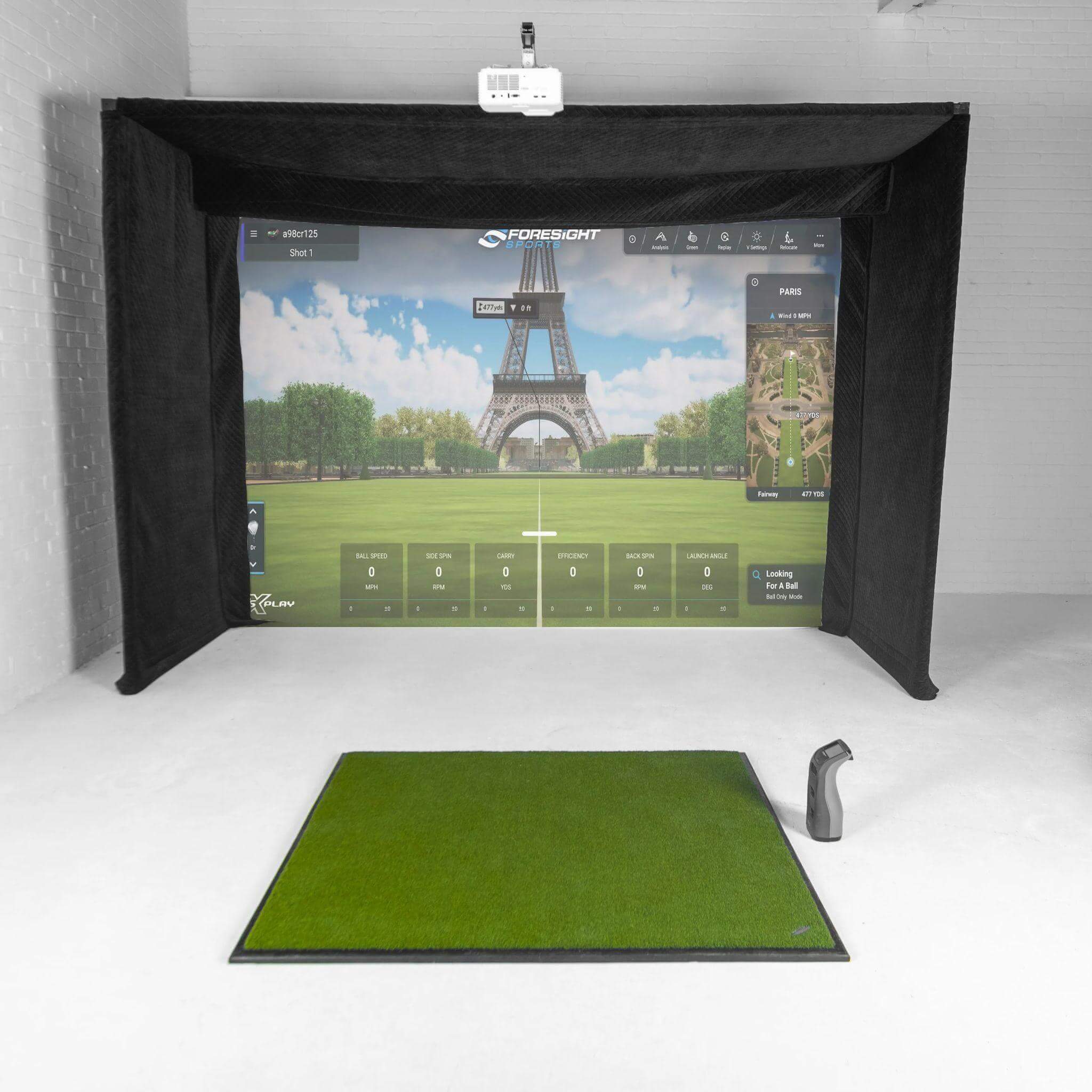
For a basement that doubles as a family room or a garage you want to keep looking like a garage, the Vanish Series from SportScreen is one of the more complete roll-up systems available. The impact screen, side screens and ceiling panel retract into a wall- or ceiling-mounted housing by hand crank or remote, with no floor track left behind to trip over.
Unlike many retractable screens, the Vanish includes 5-foot-deep side screens, a ceiling panel, baffles and a rear support membrane behind the 3-ply impact screen to calm bounce-back. It comes in five standard widths, with custom sizes up to 16 feet, and carries a 2-year warranty against defects.
- Sizes: Vanish 9, 11, 13H, 16 and 16H, plus custom
- Retraction: Hand crank or remote control
- Watch out for: It costs more than most fixed enclosures, and installation is more involved because it mounts to the structure.
3. Carl’s Place DIY Enclosure
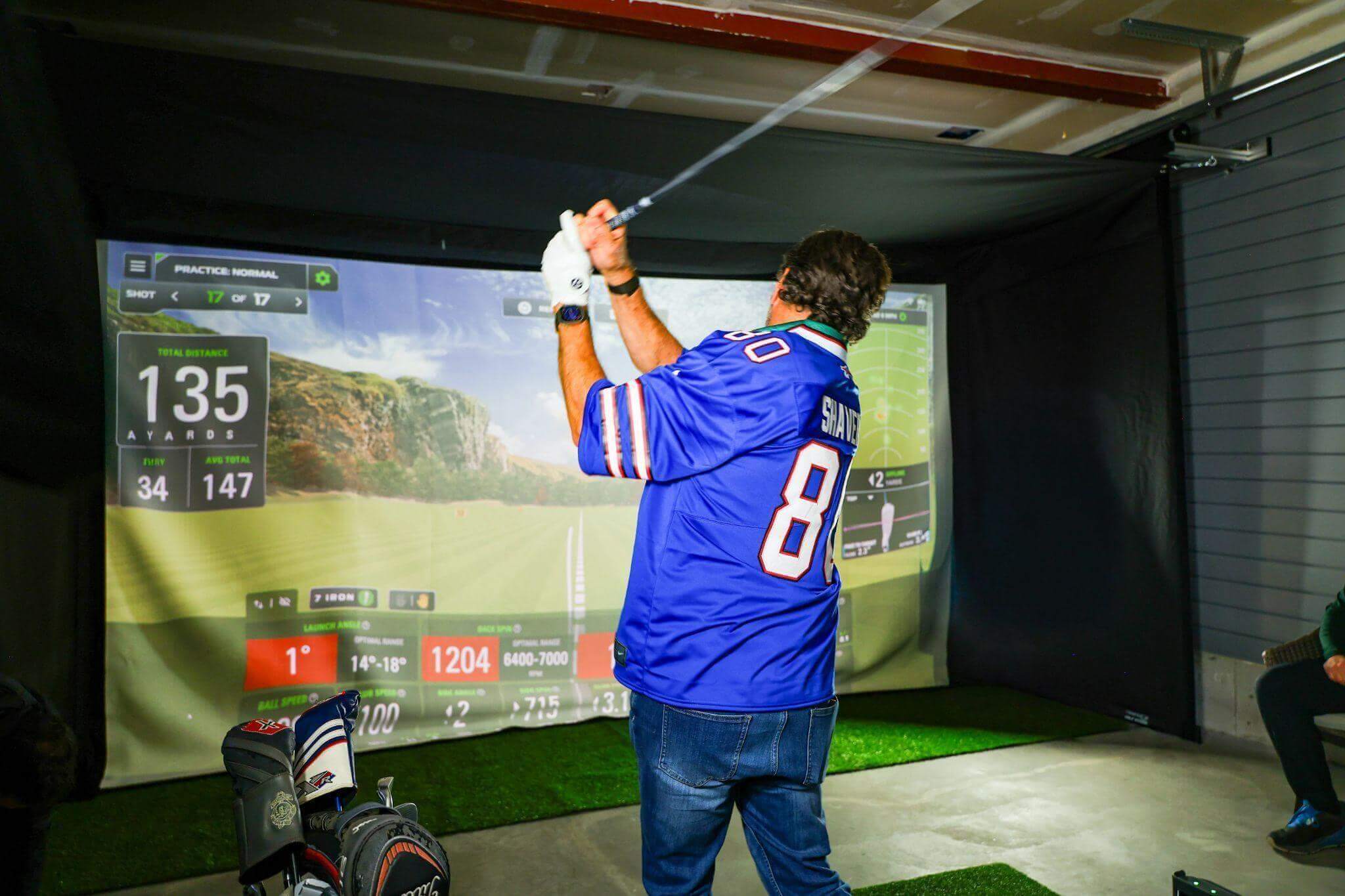
If your garage has a water heater tucked in one corner, or your basement has a soffit running across the ceiling, a fixed-size kit can leave you with wasted space or no fit at all. The Carl’s Place DIY enclosure kit gets around that with six standard sizes, from a compact 8×8 up to 9×12, plus custom dimensions down to the inch.
The kit supplies the screen, black nylon enclosure and steel corner fittings, while you source 1-inch EMT conduit locally or add a pre-cut pipe kit. Screen choices run from standard woven polyester up to a premium triple-layer and a high-contrast gray for rooms with more ambient light. The screen also runs down to the turf with no bottom border, which looks cleaner from the address.
- Sizes: 6 standard, all 5 feet deep, plus custom
- Frame: 1-inch EMT, sourced separately or added as a kit
- Watch out for: The base 1-inch frame isn’t meant for hanging a projector, and the build takes longer than a click-together kit.
4. SIG8 by The Indoor Golf Shop
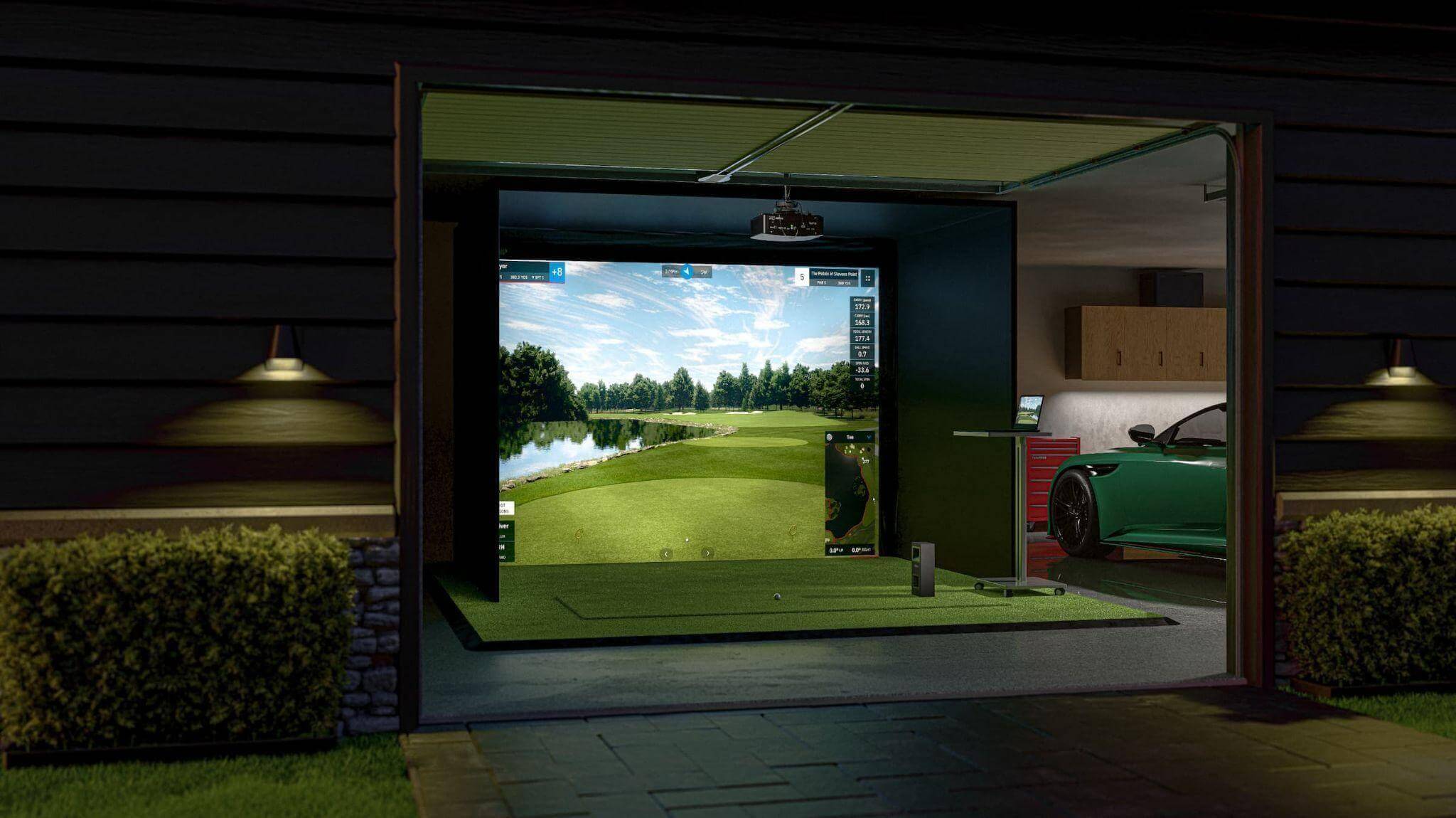
The SIG8 is The Indoor Golf Shop’s smallest enclosure, and it’s built for rooms where width is the hard limit. The full frame measures 8’4″ wide, 8’4″ high and 5 feet deep, with a 7’7″ square screen. That makes it one of the few full-screen enclosures that can sit in a single-car bay without crowding the walls.
The SIGPRO Premium screen is rated for strikes up to 250 mph, and the kit includes foam padding on all four sides, a vinyl surround, and ball bungees. Color-coded push-pin poles keep assembly simple for first-time builders.
- Sizes: One (larger SIG10 and SIG12 versions exist)
- Frame: Color-coded push-pin poles and connectors
- Watch out for: The company notes taller players may need more than a 9-foot ceiling, and the square screen gives a smaller image than a widescreen setup.
5. Rain or Shine Golf SwingBay
SwingBay is for anyone who doesn’t want a weekend-long build. The powder-coated aluminum frame uses push-button connectors, and Rain or Shine says most builds are done in under 20 minutes. At 4’2″ deep, it’s also the shallowest fixed frame on this list.
It comes in two sizes, 8′ high by 10’5″ wide or 9′ by 12′. The ballistic-grade polyester screen is rated to 250 mph, and the kit includes blackout curtains, triangular side nets with sandbags and frame padding. The frame carries a 3-year warranty, and the screen a 1-year warranty.
- Sizes: 8×10 and 9×12, both 4’2″ deep
- Screen options: Single layer or triple layer (quieter, with less bounce-back)
- Watch out for: The recommended overall footprint for the 8×10 is 11 feet wide by 15 feet deep, so it needs more floor than the frame alone suggests.
6. G-TRAK Retractable Impact Screen
Most enclosures assume the garage becomes a golf room. G-TRAK assumes it doesn’t. Its brackets clamp around your existing garage door tracks, so the door still opens and closes normally, and a remote-controlled motor lowers the screen for a session and raises it when the car comes back in.
Screen widths run from 7 feet for an 8-foot door up to 14 feet for a 16-foot double door. The viewable screen is 87 inches tall, and the short side and ceiling nets extend about 29 inches out from the screen.
- Sizes: Six, matched to door track width (8′ to 16′)
- Clearance: Floor to the bottom of the garage rail must be roughly 96″ to 103″
- Watch out for: With under 3 feet of side netting, shank protection is limited compared with a full-depth enclosure.
7. HomeCourse ProScreen 180
The ProScreen 180 is a different kind of product: an 8-foot-wide, 8-foot-high retractable screen that mounts to a wall, a ceiling or a freestanding rack and runs on a rechargeable lithium-ion battery. A wireless remote drops it into place or rolls it away in under 30 seconds, so there are no cords to route across the room.
Pro Arms on each side angle out as side nets or extend to create a projectable area about 14 feet wide for 16:9 projectors. HomeCourse lists a minimum space of roughly 8’6″ high, 10′ wide and 8′ deep for the screen itself, which is less than most fixed enclosures ask for.
- Mounting: Wall, ceiling or freestanding rack
- Screen: 8′ x 8′, ballistic-grade material
- Watch out for: In a tight room, plan on extra side netting or wall padding, since there’s no full enclosure around you.
8. GoSports 10′ x 8′ Golf Simulator Enclosure
At around $1,000, the GoSports enclosure costs roughly half of what the premium kits on this list run, and it still includes a steel frame, a 4:3 HD impact screen, side and top covers and foam padding. Assembly takes about 30 minutes.
It measures 10’7″ wide, 8′ high and 6′ deep, and GoSports also sells 8×8 and 12×9 versions, plus a variant with added shank nets.
- Sizes: 8×8, 10×8 and 12×9
- Frame: Snap-together steel
- Watch out for: Reviewers have reported strong bounce-back out of the box, so expect to adjust screen tension with the bungees.
How to Choose a Golf Simulator Enclosure for a Garage or Small Room
Start With the Ceiling, Not the Screen
Ceiling height rules out more home simulators than anything else. Most manufacturers recommend 9 to 10 feet. Before you compare screen sizes, stand where the hitting mat will go and make slow, full swings with your actual driver, paying attention to where the club peaks rather than the middle of the room. A hitting mat also raises you an inch or so.
Garages add a wrinkle: the door, its tracks and the opener often hang lower than the drywall. Measure to the lowest obstruction in your swing path, not the ceiling itself.
Measure Depth for Your Launch Monitor Type
Room depth depends on where your launch monitor sits, and the indoor golf simulators built for performance training vary a lot here, from camera units beside the ball to radar systems that need open space behind you. Camera-based units generally need less room, often around 13 to 15 feet total, while radar units behind the golfer usually need 16 feet or more. Within that, many setups put the ball about 10 feet from the screen. Garage builds that end up closer, at 8 or 9 feet, are better served by a triple-layer screen that absorbs more energy and sends less ball back at you.
Leave Room on the Sides
The enclosure’s width is only part of the picture. Leave a few inches of buffer around the frame, and if the room is narrow, decide where the mat goes before anything is bolted down. Shared households with left- and right-handed players usually center the mat, while single-player setups can offset it to give the club more room on the backswing side.
Decide Between Fixed, Retractable and Door-Mounted
- Fixed enclosures (SimBox, SIG8, SwingBay, Carl’s Place, GoSports) give the best shank protection and light control, but they claim floor space full-time. A folding frame softens that trade-off.
- Wall- or ceiling-mounted retractables (Vanish, ProScreen 180) clear the room in seconds but need solid mounting and usually cost more.
- Door-track-mounted screens (G-TRAK) are the only option here built specifically around keeping a car inside.
Plan for Garage Temperature and Humidity
An unconditioned garage runs hotter and colder than the rest of the house, which is hard on projectors, PCs and launch monitors. In winter, heat escapes from the heated rooms next door into the garage, which is why insulating the walls and door makes the space far more usable year-round.
Moisture matters too. The EPA’s guidance on mold and moisture recommends keeping indoor humidity below 60 percent, ideally between 30 and 50 percent. A small dehumidifier is cheap insurance for screen fabric, turf and electronics that live in the space.
Don’t Ignore the Floor
A hitting mat on bare concrete works, but a dusty, cracked or oil-stained slab is harder to keep clean, and that dust settles on screens and projector lenses. Many garage golfers seal the floor first, since the epoxy and polyaspartic systems covered in this guide to concrete floor coatings stop the fine dust bare concrete sheds and make spills easy to wipe up.
Think About Noise
A ball hitting an impact screen is loud, especially in a garage that shares a wall with bedrooms. Triple-layer screens, foam backing panels, and acoustic tiles can all help, and they’re worth budgeting for when the simulator sits next to living areas.
Matching an Enclosure to Three Common Spaces
The Single-Car Garage That Still Parks a Car
This is the hardest space to work with, because the enclosure has to disappear daily. A door-track-mounted screen like the G-TRAK is the most practical fit, provided your rail sits in its required height range. A folding fixed frame is the alternative if you’re willing to break it down and store it against a wall. Either way, check that the depth from the screen to the back wall still leaves enough room for your launch monitor once the car is out.
The Two-Car Garage With One Bay to Spare
Here a fixed enclosure in the 10- to 12-foot width range makes sense, since you get full shank protection without touching the parked side. A mid-size SimBox, the SwingBay 8×10 or a Carl’s Place 8×10.5 all fit this footprint. Leave a clear walkway between the bay and the car, and consider side nets on the vehicle side so a mishit doesn’t find a mirror.
The Basement or Spare Room With a 9-Foot Ceiling
With 9 feet overhead, compact frames like the SIG8 (8’4″ high), the lowest SimBox (8’2″ high) or the SwingBay 8×10 can fit, but test your driver swing before ordering. If the ceiling is closer to 8 feet, most adults won’t get a comfortable full driver swing, and the setup works better for irons, wedges and short-game practice. Shallow rooms in this group are also where a wall-mounted retractable screen like the ProScreen 180 earns its place.
Frequently Asked Questions
What is the minimum ceiling height for a golf simulator enclosure?
Most golfers need at least 9 feet of ceiling height to swing a driver comfortably, and 10 feet removes most of the worry. Taller players and steeper swings may need more. Some frames stand just over 8 feet tall, but a frame fitting is not the same as your swing fitting. Always test with a slow driver swing where the mat will go.
Can you fit a golf simulator in a one-car garage?
Yes, if the bay is about 10 feet wide or more and the ceiling allows a full swing. Compact frames like the SIG8 (8’4″ wide) or the smallest SimBox (8’6″ wide) are designed for this footprint. Depth is usually the harder constraint, since the hitting area plus launch monitor space often needs 13 to 16 feet. Retractable options help when the car still needs the space.
How deep does a room need to be for a golf simulator?
Plan for roughly 13 to 15 feet with a camera-based launch monitor and 16 feet or more with a radar unit that sits behind you. That covers the enclosure, the ball-to-screen distance and room to stand. Shallower rooms can work with a triple-layer screen and a shorter hitting distance. Check your launch monitor’s own requirements before buying anything else.
Can I still park my car in the garage with a golf simulator?
You can with the right setup. Door-track-mounted screens like G-TRAK roll up and leave the garage door working normally. Folding frames can be taken down and stored, and wall-mounted retractables clear the floor in seconds. A permanent fixed enclosure generally means giving up the bay.
Are retractable or fixed enclosures better for small spaces?
Fixed enclosures offer better shank protection, light control and image quality, so they suit rooms you can dedicate to golf. Retractable systems are better when the space has another job, like parking or movie nights. The trade-off is usually price and installation, since retractables mount to walls, ceilings or door tracks. Folding fixed frames sit in between.
Do golf simulator enclosures come with an impact screen?
Most complete kits do, including every enclosure on this list. Some DIY kits, like Carl’s Place, include the screen but leave the frame pipe for you to source. Check whether side nets, foam padding and blackout material are included, since those are often extras. Buying the screen and frame together avoids sizing gaps.
How much does a golf simulator enclosure cost?
Most home enclosures cost between about $1,000 and $3,500 before add-ons. Budget kits like GoSports sit at the low end, while retractable systems and larger sizes push toward the top. You’ll also need a hitting mat, projector, launch monitor and software. Prices change often, so check current listings.
Will a cold or humid garage damage my simulator?
It can, mostly through the electronics rather than the enclosure itself. Temperature extremes and condensation are hard on projectors, PCs and launch monitors, and damp air can encourage mold on fabric. Insulating the garage and keeping humidity below 60 percent both help. Many owners bring the launch monitor and laptop inside between sessions.
How close can I stand to the impact screen?
Many setups place the ball about 10 feet from the screen, though garage builds often land at 8 or 9 feet. The closer you get, the more bounce-back and noise you’ll notice, so a triple-layer screen is worth it at shorter distances. Follow your enclosure maker’s minimum distance and your launch monitor’s tracking requirements. Proper bungee tension also cuts bounce-back.
Do I need a professional to install a golf simulator enclosure?
Most freestanding enclosures are designed for DIY setup in under an hour, often without tools. Retractable systems that mount to ceilings, walls or door tracks take more work and may be worth hiring out. Projector mounting and new electrical outlets are the parts most likely to need a pro. Leave any wiring to a licensed electrician.
Final Thoughts
A small garage or spare room can absolutely hold a good simulator, but the enclosure has to be chosen around the space, not the other way around. Measure your ceiling at the lowest obstruction, match depth to your launch monitor, and decide early whether the room needs to go back to being a garage at the end of the night. Get those three answers right and any enclosure on this list will give you a bay you actually use all winter.