Mature trees can be one of the best features of a property. They provide shade, add character, and can make a yard feel established. But as trees age, they can also develop problems that are not always obvious from the ground.
A tree does not have to be dead to become a safety concern. Storm damage, disease, weakened roots, decay, and structural problems can all increase the chance of branches or entire trees failing.
This is especially important for homeowners in Delaware and southeastern Pennsylvania, where mature trees are common and seasonal storms can bring strong winds, heavy rain, snow, and saturated soil.
Knowing what to look for can help homeowners identify potential problems before they turn into emergencies.
A quick safety note before you start: these signs are for spotting problems from the ground, not for fixing them yourself. Pruning or removing large limbs, especially storm-damaged ones under tension, is one of the more dangerous jobs around a property. If a tree or branch is touching or near a power line, stay well back and call your utility company.
1. The tree has started leaning
Some trees naturally grow at an angle. That alone does not mean a tree is dangerous. A new or increasing lean is different.
If a tree that once stood straight begins leaning toward a house, driveway, road, or other structure, it may be a sign that the root system or soil around the tree has changed.
Look for other warning signs near the base of the tree, including:
- lifted or cracked soil
- exposed roots
- roots pulling out of the ground
- recent excavation near the tree
- soil erosion
- a lean that appeared after a storm
Heavy rain can be especially important. Saturated soil may reduce the support around a tree’s root system, making an already weakened tree more likely to move.
A tree that suddenly develops a noticeable lean should be inspected as soon as possible.
2. Large branches are dead or falling
Dead branches are one of the easiest warning signs for homeowners to spot.
A dead branch may have:
- no leaves during the growing season
- peeling or missing bark
- dry, brittle wood
- no new growth
- smaller dead branches attached to it
The larger and higher the branch is, the greater the potential risk if it falls. Branches over roofs, patios, driveways, sidewalks, play areas, or parking spaces deserve particular attention.
Homeowners should also watch for what arborists call “hangers,” sometimes nicknamed “widowmakers”: branches that broke during a storm but stayed caught in the canopy instead of falling. These branches can be difficult to see from the ground and may fall later without much warning.
Routine pruning helps keep deadwood from building up in the first place. Our guide to tree trimming and topping covers the basics.
3. There are cracks or splits in the trunk
A mature tree carries a tremendous amount of weight.
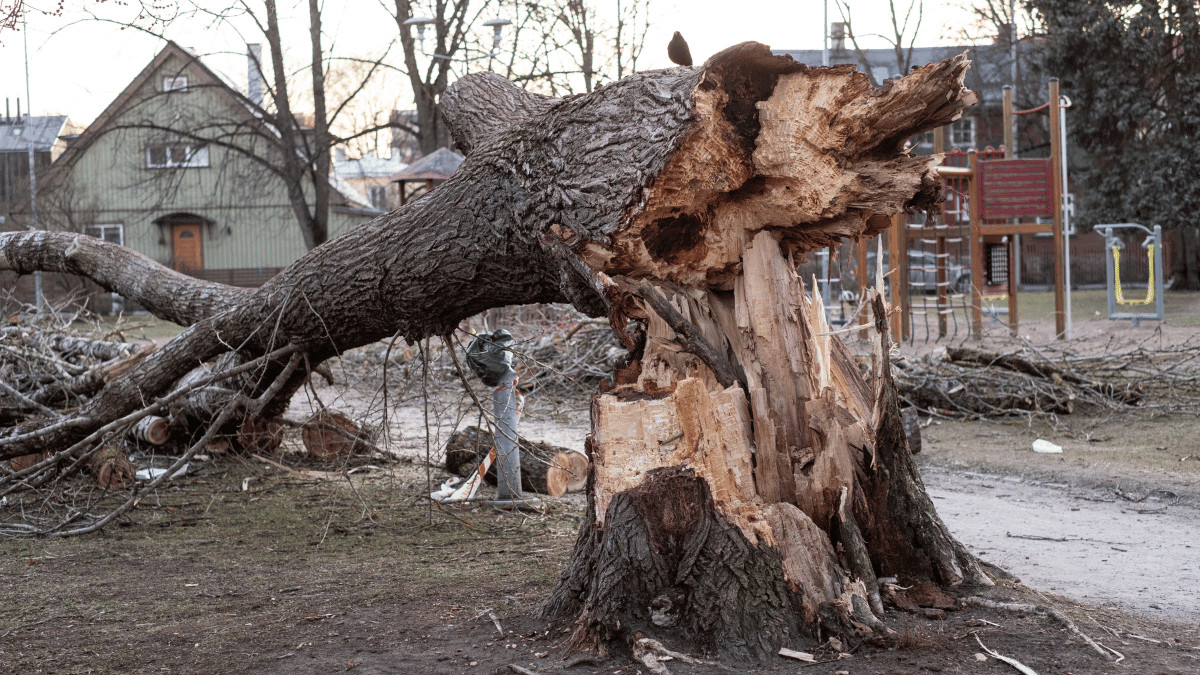
Cracks in the trunk or where major branches connect can weaken the tree’s structure and increase the chance of failure.
Pay attention to:
- vertical cracks in the trunk
- deep splits between large branches
- sections of trunk beginning to separate
- cracks that have recently become larger
- openings that expose internal wood
Not every crack means a tree needs to be removed. Some trees can be monitored, pruned, or supported depending on their condition.
The important part is determining whether the crack affects the tree’s structural strength.
That is difficult to judge from appearance alone.
4. The trunk has cavities, decay, or mushrooms
A tree can look healthy on the outside while decay is developing inside the trunk or roots.
Large cavities are an obvious warning sign, but decay can also be more subtle.
Homeowners may notice:
- hollow areas
- soft or crumbling wood
- missing bark
- large wounds that are not closing
- mushrooms or fungal growth near the trunk
- fungal growth around the roots
Fungi around the base of a tree can sometimes indicate that dead or decaying wood is present below the surface.
That does not automatically mean the tree will fall. The amount and location of decay matter.
A mature tree may continue living for years with some internal decay. The question is whether enough healthy wood remains to safely support the tree.
An arborist can evaluate the condition rather than making a decision based only on the presence of a cavity or mushroom.
5. The roots have been damaged
Roots are easy to overlook because much of the system is underground.
They are also critical to keeping a tree stable.
Root damage can happen during:
- home additions
- driveway installation
- landscaping
- utility work
- excavation
- grading
- construction
- trenching
Heavy equipment repeatedly driving across the soil can also compact the ground around roots.
A tree may remain standing after root damage and only begin showing signs of stress months or even years later.
Homeowners planning construction around mature trees should consider the root system before work begins. Protecting healthy roots is often much easier than trying to correct serious damage afterward.
6. The tree looks different after a storm
Severe weather can expose weaknesses that were already developing inside a tree.
After strong winds, heavy rain, snow, or ice, walk around the property and look at mature trees from several angles. Along with the signs above, such as new leaning, fresh cracks, and exposed roots, watch for:
Watch for:
- new leaning
- broken branches
- hanging limbs
- fresh cracks
- exposed roots
- sections of canopy that suddenly look uneven
- branches resting on a roof
- changes around the base of the tree
Storm damage does not always mean a tree needs to be removed.
In some cases, proper pruning can remove damaged limbs while preserving the tree. In others, the storm may reveal structural problems that make removal the safer option.
The condition of the entire tree needs to be considered.
7. The tree is declining from the top down
The canopy can tell homeowners a great deal about a tree’s health.
One warning sign is significant dieback near the top of the tree.
You may notice:
- fewer leaves than surrounding trees
- dead branches near the top
- unusually small leaves
- sections of the canopy that do not leaf out
- thinning that becomes worse each year
There are many possible causes.
The tree may be dealing with disease, insects, drought stress, soil problems, root damage, or age-related decline.
Early evaluation matters because removal is not always the only solution. Depending on the cause, pruning, plant health care, soil management, or other treatments may help preserve the tree.
When should a tree be inspected by an arborist?
Homeowners do not need to wait until a tree looks ready to fall.
An inspection makes sense when a mature tree:
- hangs over a house or other structure
- develops a new lean
- loses a large branch
- has visible cracks or decay
- was affected by construction
- changes significantly after a storm
- begins showing major canopy decline
- causes concern even when the problem is difficult to identify
For properties with many mature trees, periodic inspections can also help identify problems early. This can be particularly useful in older, established neighborhoods, which often contain large trees close to homes, roads, utility areas, and other structures.
For a formal evaluation, ask whether the arborist holds the ISA Tree Risk Assessment Qualification (TRAQ), a credential specifically for assessing the likelihood and consequences of tree failure.
Does a dangerous-looking tree always need to be removed?
No.
One of the most important parts of professional tree care is determining what actually needs to be done.
Depending on the condition of the tree, an arborist may recommend:
- monitoring
- selective pruning
- removal of dead branches
- structural pruning
- plant health care
- cabling or other support
- additional testing
- full tree removal
Removal becomes more likely when a tree has serious structural defects and there is a significant risk to people or property.
A healthy mature tree has value. The goal should be to preserve trees when it can be done safely and remove them when the risk becomes unacceptable.
Local tree risk can change with the seasons
Trees in Delaware and southeastern Pennsylvania face changing conditions throughout the year.
Winter snow and ice can add weight to branches. Spring rain can saturate soil. Summer thunderstorms can bring strong winds. Drought and heat can place additional stress on already weakened trees.
That is why tree safety is not only about what a tree looks like today. Its history, structure, location, health, and exposure to severe weather all matter.
When choosing someone to look at a tree, credentials matter more than equipment or price. Look for a company with ISA-Certified Arborists on staff, people trained to evaluate tree health, structural concerns, pruning needs, storm damage, and whether removal is necessary. Local experience helps too. A company like Strobert Tree Services, which has worked across Delaware and southeastern Pennsylvania since 2000, will be familiar with the region’s common species, soils, and storm patterns.
If removal does turn out to be necessary for large trees near homes and other structures, ask how the work will be done. Cranes and rigging systems can allow arborists to take a tree down in sections while limiting impact on the surrounding property.
The most useful time to evaluate a questionable tree is before it becomes an emergency. Homeowners who notice a new lean, dead limbs, cracks, root movement, decay, or major changes after a storm should have the tree assessed by a qualified tree-care professional.