Imagine your roof. Just one inch of rain on a 1,000-square-foot surface adds up to about 620 gallons. That’s over a dozen 50-gallon barrels dumping their contents all at once. And all that water? It needs a place to go.
Here’s the thing: weather damage almost never shows up with a big sign. It sneaks in. Maybe your gutter starts sagging, or a downspout kicks water right onto the wall. Over time, soil shifts and little problems grow quietly.
That’s why your exterior maintenance projects before storm season should start with catching issues early, figuring out what you can handle, what needs an expert, and ending the yearly “storm prep” scramble.
Start Simple: Walk the House Before Storm Season
Don’t grab the toolbox yet. Just take your coffee, your phone, and some binoculars if you have them. Walk the whole way around your house. Look up at the roof edges for shingles curling or poking out, and for gutters that are coming loose.
Scan the siding; are there any odd cracks, warped bits, or bubbles in the paint? Snap photos if something looks weird. Trust me, you’ll be glad you have them later.
While you’re at it, look closely at the caulk around your windows and the weatherstripping on exterior doors. Wind-driven rain finds the smallest gaps, so caulk that’s cracked or pulling away, and door seals you can see daylight through, are worth fixing before the storms start. Resealing a window frame is usually a quick DIY job. Windows that won’t close properly, or frames that feel soft or rotted, are a job for a pro.
If you can, do this walk right after it rains. Everything’s easier to spot when it’s wet. Dry weather hides the real trouble.
What Gutters Are Trying to Tell You
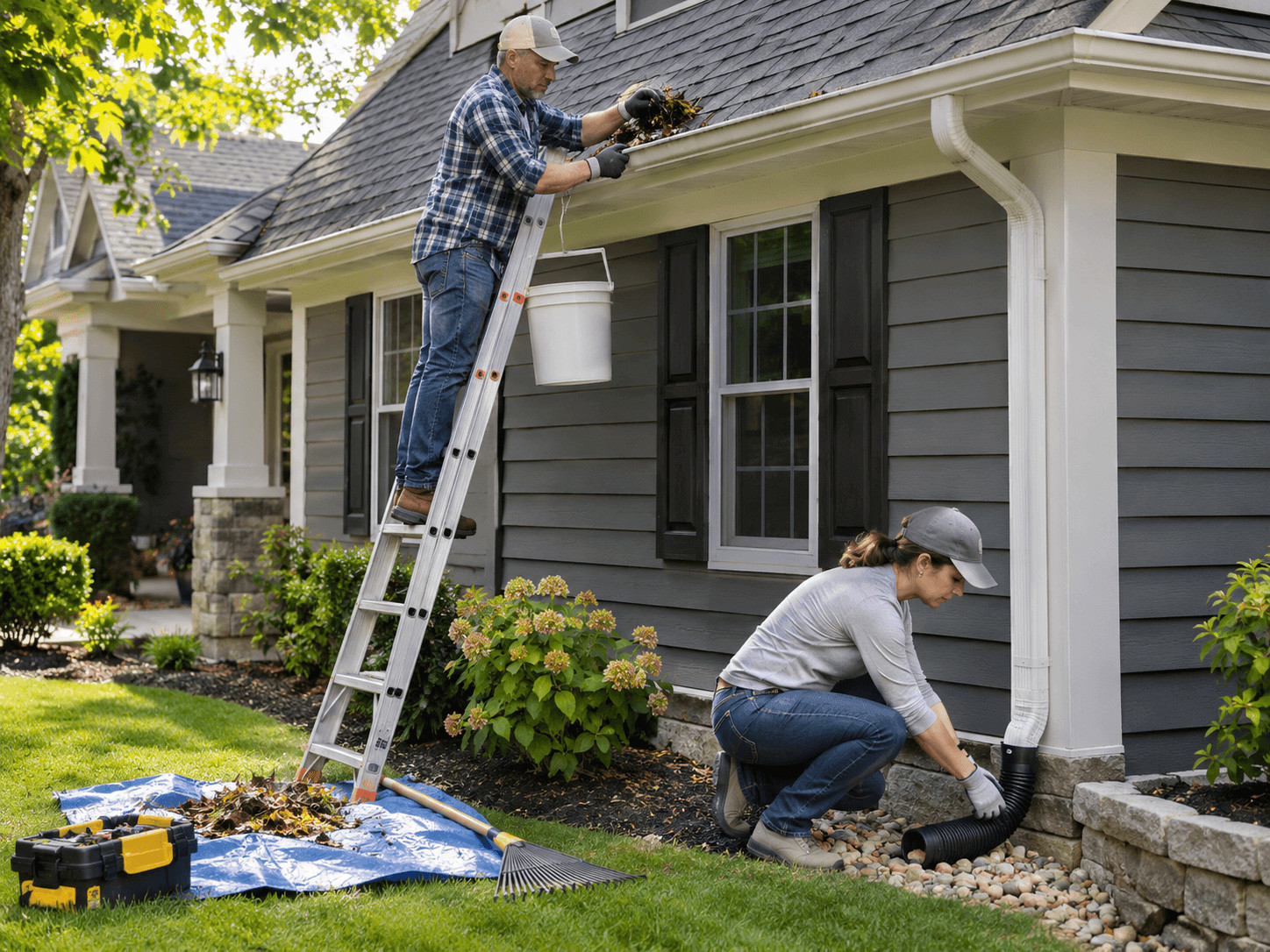
Gutters catch blame for a lot of mess, and honestly, they’ve earned it. When leaves and gunk pile up, water spills over. That overflow soaks wood, stains your siding, and seeps into the foundation.
That’s why cleaning is really the unglamorous heart of keeping roof drainage working reliably, and why it beats waiting until the heavy rains have already arrived.
Here’s what you need to check: First, the slope. Gutters should drop about a quarter inch every ten feet toward the downspout. If you see water stuck in them long after a storm, check for clogs, sagging sections, or incorrect pitch.
Next, look at the fasteners. Loose hangers and open seams mean the gutter is already moving.
Finally, where do those downspouts end? They should carry water at least five feet from the house; ten is even better. If a spout stops right at your wall, it’s just pointing trouble straight at your basement.
And a quick safety note: if cleaning means a tall ladder or you’re near the roof’s edge, let a pro handle it. No gutter is worth landing in the ER.
Spotting Water Trouble
After gutters, listen to what your house is showing you. Dark marks under the roof, peeling paint near corners, soft trim; these mean water’s been misbehaving for a while.
Now, look down. After rain, does water pool near your foundation? That’s a red flag. The standard says the ground should drop at least six inches over the first ten feet away from your house. The test is easy: grab a stake, some string, and a level.
Run the string out from your wall, keep it level, and measure the drop at ten feet. Less than six inches, and water’s probably running back toward your home.
Some fixes are simple. Extend your downspouts, add dirt where the ground has settled, and keep mulch away from the siding.
But if you see cracks in the foundation, wet basement walls, or you’ve got a yard that needs big changes to the grading, call in a professional. The tricky part? Sometimes a minor crack and a bigger foundation problem look the same. If you’re unsure, don’t risk it.
Fix, Replace, or Bring in Help
You don’t need to jump into replacing things just because something looks off. Got a loose gutter hanger or a minor leak at a seam? Have the hanger secured or the seam properly resealed, then check that the repair holds.
But if the fix doesn’t stick- if you’re patching the same spots every spring, or the metal is rusting away, or gutters keep pulling apart, it’s time to stop tinkering and think of a replacement.
Those are the signs an aging gutter system needs replacement, and another weekend of patching only delays the bill. It depends on the material and history, of course. One bad corner on a fairly young run isn’t the same as a sagging line from end to end.
Roof edges? Those are a bit different. If you have missing shingles or messed-up flashing, bring in a roofer. You can save everyone time by handing over those photos from your walk.
Don’t forget what’s growing and sitting around your house. Limbs hanging over the roof can snap in high wind, so trim them back and remove anything dead. Then do a quick sweep for loose items like patio chairs, grills, planters, and kids’ toys that can turn into projectiles when the wind picks up. Store them or tie them down before the season starts, not the night before the storm.
Which Exterior Maintenance Projects to Do First
It’s easy to get overwhelmed. Picture a homeowner with clogged gutters, a downspout dumping near their foundation, peeling paint, and some flat low spots in the yard. Where do they start?
Always tackle water first. Clean the gutters and get those downspouts to drain away from your house. Those are quick fixes that protect everything else.
Next, knock out repairs that plug active leaks, like fixing a loose gutter or sealing a joint. After that, roll up your sleeves for the bigger jobs like soil work, repainting, or fixing siding.
Rank projects by what causes the most damage, not just what’s ugly. Faded paint is cosmetic. Water funneling into your foundation? That’s real money.
A Maintenance Schedule You’ll Actually Use
Here’s what sets the ahead-of-the-curve folks apart: they keep it simple and routine. Put two walkarounds on your calendar, spring and fall. Do a quick check after a big storm.
That’s maybe fifteen minutes to circle the house, an hour to clear the gutters, a few notes in your phone, and you’re done. Keep photos in one spot so you can compare each year.
Got heavy leaf fall? You’ll need to clean gutters more often. Adapt to what your house needs.
Small Routines, Bigger Gains
Houses rarely fail overnight. Problems build slowly, water wins a bunch of tiny battles, and one day, it wins big.
If you finish your exterior maintenance projects before storm season, the big storm has a lot less power to do damage. So make it easy for yourself. Take that walk this weekend, and go ahead; bring the coffee.