Not every home improvement project can be completed with parts from a local hardware store. If you’re installing a custom outdoor kitchen, upgrading a workshop, building a home brewing setup, fabricating metal furniture, or tackling a specialized plumbing project, finding high-quality stainless steel fittings can make all the difference.
Finding The Right Supply Store
Not all industrial supply stores are built the same, and that gap becomes obvious the moment you need a sanitary tri-clamp fitting on short notice or a custom-fabricated process component that meets ASME-BPE standards. After reviewing dozens of suppliers across food, pharmaceutical, HVAC, and compute cooling sectors, the quality and availability differences are stark.
Managing procurement across multiple facilities, keeping product specs consistent, and avoiding supply chain surprises are daily headaches in this space. This guide breaks down five suppliers worth knowing, from full-service sanitary process specialists to massive broad-line distributors.
How this ranking was put together
Each supplier was evaluated by pulling publicly available information from official websites, case studies, industry directories, and feedback from customers. Only suppliers with a documented track record in industrial supply made the final cut. Sources were cross-referenced to make sure the picture was accurate before any company was included.
→ See the full research breakdown
- Central States Industrial (CSI) Store – Best for food, dairy, beverage, and pharmaceutical facilities needing engineered fabrication and sanitary parts
- Daikin Applied – Best for commercial and industrial HVAC systems
- CoolIT Systems – Best for high-performance computing and AI infrastructure cooling
- Schneider Electric – Best for industrial automation, energy management, and environmental responsibility
- McMaster-Carr – Best for industrial supply and B2B distribution
Why Industrial Supply Stores Are Worth a Closer Look
Choosing the wrong supplier doesn’t just create headaches at the purchasing desk. It creates problems on the production floor. When a facility is running sanitary process lines, the cost of sourcing the wrong fitting or waiting three weeks for a back-ordered valve shows up in lost output and compliance risk.
Specialized industrial supply stores carry the technical depth that broad retail channels simply don’t stock. They understand material certifications, lead times for regulated components, and the difference between a fitting that passes inspection and one that doesn’t. That knowledge directly affects order fulfillment rates, on-time delivery performance, and total procurement cost across the life of a facility.
Comparing the 5 Best Industrial Supply Stores
| Company Name | Years Operating | Headquartered In |
| Central States Industrial (CSI) Store | 47+ years (est. 1977) | Springfield, MO |
| Daikin Applied | 100+ years (est. 1924) | Plymouth, Minnesota |
| CoolIT Systems | 23+ years (est. 2001) | Calgary, Canada |
| Schneider Electric | 186+ years (est. 1838) | Rueil-Malmaison, France |
| McMaster-Carr | 120+ years (est. 1901) | Elmhurst, Illinois |
Central States Industrial (CSI) Store – Best for Sanitary Process Fabrication and Distribution
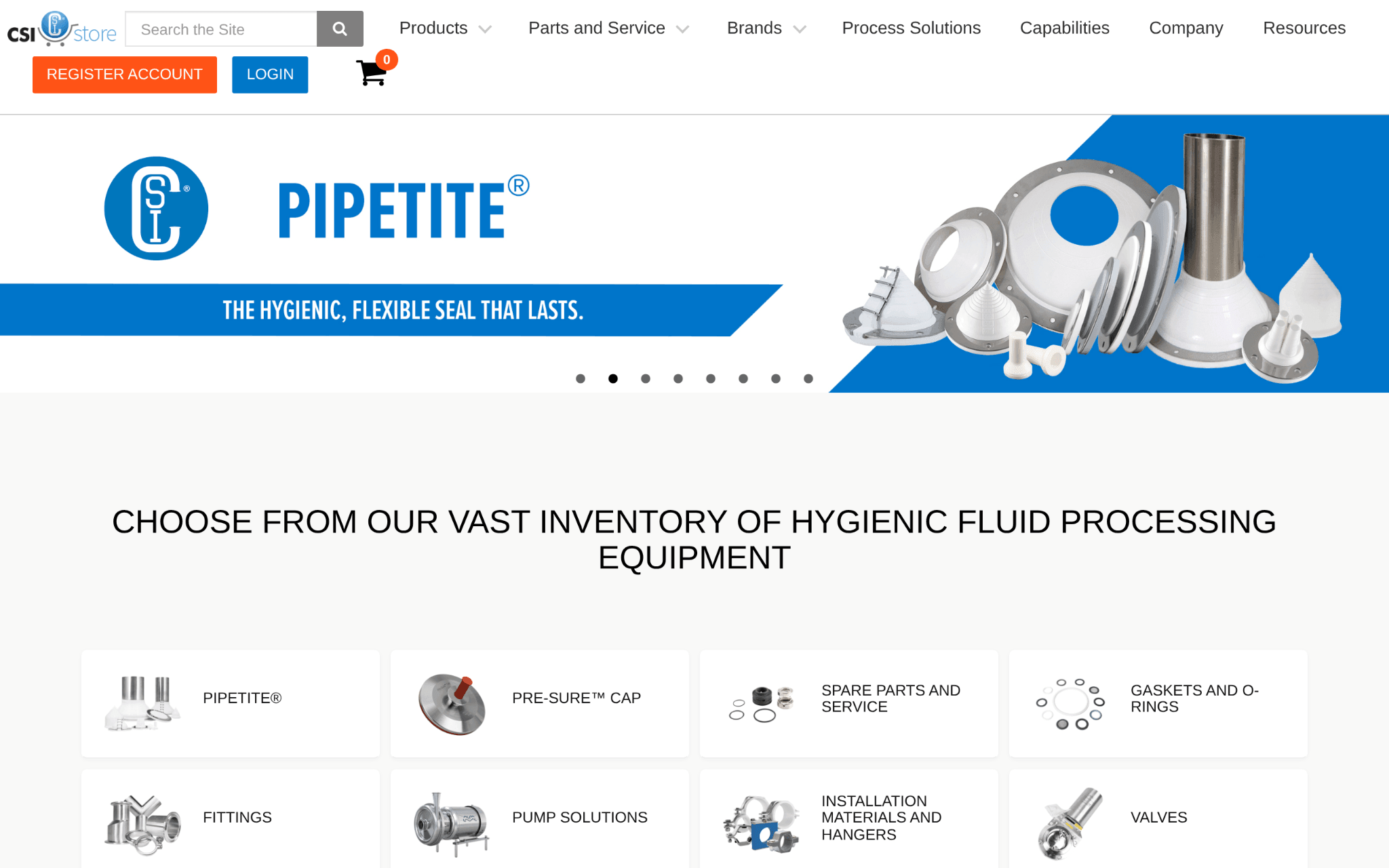
How Is Central States Industrial (CSI) Store Positioning Itself in the Market?
Central States Industrial (CSI) Store covers the full range of sanitary processing needs, from stocked fittings and valves to custom fabricated process systems built in-house. They run five US distribution centers, which means they can actually ship parts quickly rather than making you wait on a transfer from a single warehouse. Their ASME Section IX certified welders and CNC machinists work in a climate-controlled facility, and they hold 3-A and ASME-BPE compliance, which matters a lot for food, dairy, pharmaceutical, and biotechnology clients. As a master distributor for Alfa Laval, they carry real weight in the sanitary processing market.
What Sets Central States Industrial (CSI) Store Apart for Industrial Supply Stores?
Facilities running regulated process lines need a supplier that understands both the part and the standard it has to meet, and that’s exactly where CSI delivers. Their combination of stocked inventory across five locations and in-house fabrication capability removes a frustrating gap that most distributors leave open.
What Users Are Actually Saying:
Customers consistently point to CSI’s technical knowledge as the reason they keep coming back. The ability to get both off-the-shelf parts and custom fabricated components from one supplier is something customers flag as genuinely useful and convenient. Their 47-year track record builds the kind of trust that repeat buyers rely on.
2. Daikin Applied – Best for Commercial and Industrial HVAC Systems
How Is Daikin Applied Positioning Itself in the Market?
Daikin Applied operates inside a very large global network as part of Daikin Industries, Ltd., a Forbes 2000 company with close to $30.8 billion in 2024 revenues. Their product line covers rooftop systems, chillers, air handlers, fan coils, and water source heat pumps. With 170 sales, service, and parts offices worldwide and 24/7 support across the US and Canada, they’re built for clients who need coverage and fast response. Industry recognition includes gold awards in the HVAC Commercial Equipment category, which signals they’re not just large but technically respected.
What Sets Daikin Applied Apart for Industrial Supply Stores?
Large industrial facilities often struggle to find HVAC suppliers who can cover both equipment supply and on-site service without involving three separate vendors. Daikin Applied addresses that directly. Their global infrastructure means parts availability and service response don’t fall apart the moment a facility is in an unusual location.
What Users Are Actually Saying:
Customers tend to value the depth of Daikin Applied’s service network as the standout factor. The combination of rental equipment availability and temporary heating and cooling support earns positive mention, especially for facilities managing planned shutdowns or emergency situations. The global scale reassures procurement teams who need confidence in long-term parts availability.
3. CoolIT Systems – Best for High-Performance Computing and AI Infrastructure Cooling
How Is CoolIT Systems Positioning Itself in the Market?
CoolIT Systems focuses on liquid cooling for AI and high-performance compute environments, with a product portfolio that includes cold plates, coolant distribution units, rack manifolds, and integrated cooling loops. Their modular Rack DLC technology is deployed across some of the most demanding infrastructure in the world, including seven of the top ten supercomputers. Operating out of Calgary with manufacturing spread across Canada, China, and Vietnam, and ISO9001:2015 certified production lines, they serve hyperscalers and large compute cluster operators who can’t afford cooling failures.
What Sets CoolIT Systems Apart for Industrial Supply Stores?
Data center and HPC operators face a real supply problem when AI workloads push heat density beyond what air cooling can handle, and CoolIT built their entire business around solving exactly that. Their end-to-end model, covering design, manufacturing, project management, and onsite service, means buyers aren’t left piecing together a system from multiple suppliers.
What Users Are Actually Saying:
CoolIT earns recognition for the scale and reliability of their deployments. Their Deloitte Technology Fast 500 award and Financial Times ranking as one of the Americas’ fastest growing companies in 2023 are the kinds of signals that procurement teams notice when evaluating supplier stability. Clients at institutions like Lawrence Livermore National Lab tend to share positive feedback about the technical depth behind each deployment.
4. Schneider Electric – Best for Industrial Automation, Energy Management, and
Environmental Responsibility

How Is Schneider Electric Positioning Itself in the Market?
Schneider Electric covers a wide territory, from low voltage systems and solar energy storage to medium voltage distribution and industrial automation. Their EcoStruxure IoT-enabled platform ties together energy management and automation across industries, data centers, infrastructure, and buildings. At Fortune Global 500 scale with 159,000 employees and 186 years of operating history, they bring resources that most industrial suppliers can’t match. Recognition as the World’s Most Sustainable Company by TIME Magazine and Statista, and a top 1% rating for environmental responsibility, gives them a distinct position for facilities with environmental targets.
What Sets Schneider Electric Apart for Industrial Supply Stores?
Industrial facilities trying to manage energy costs alongside production demands need more than just hardware supply. They need systems that actually talk to each other, and that’s the space Schneider built EcoStruxure to fill. Being named one of the Top 100 Most Ethical Companies for 13 consecutive years isn’t a small thing (think long-term procurement confidence) and supports the case for treating them as a stable, trusted supply partner.
What Users Are Actually Saying:
Customers across industrial and infrastructure sectors point to the breadth of Schneider’s product portfolio as both a strength and something to plan around. The EcoStruxure platform earns consistent praise for bringing visibility into energy and asset performance. Their World Economic Forum designation as a Circularity Lighthouse is the kind of credential that resonates with operations teams focused on environmental impact.
5. McMaster-Carr – Best for Broad Industrial Supply and Fast B2B Distribution
How Is McMaster-Carr Positioning Itself in the Market?
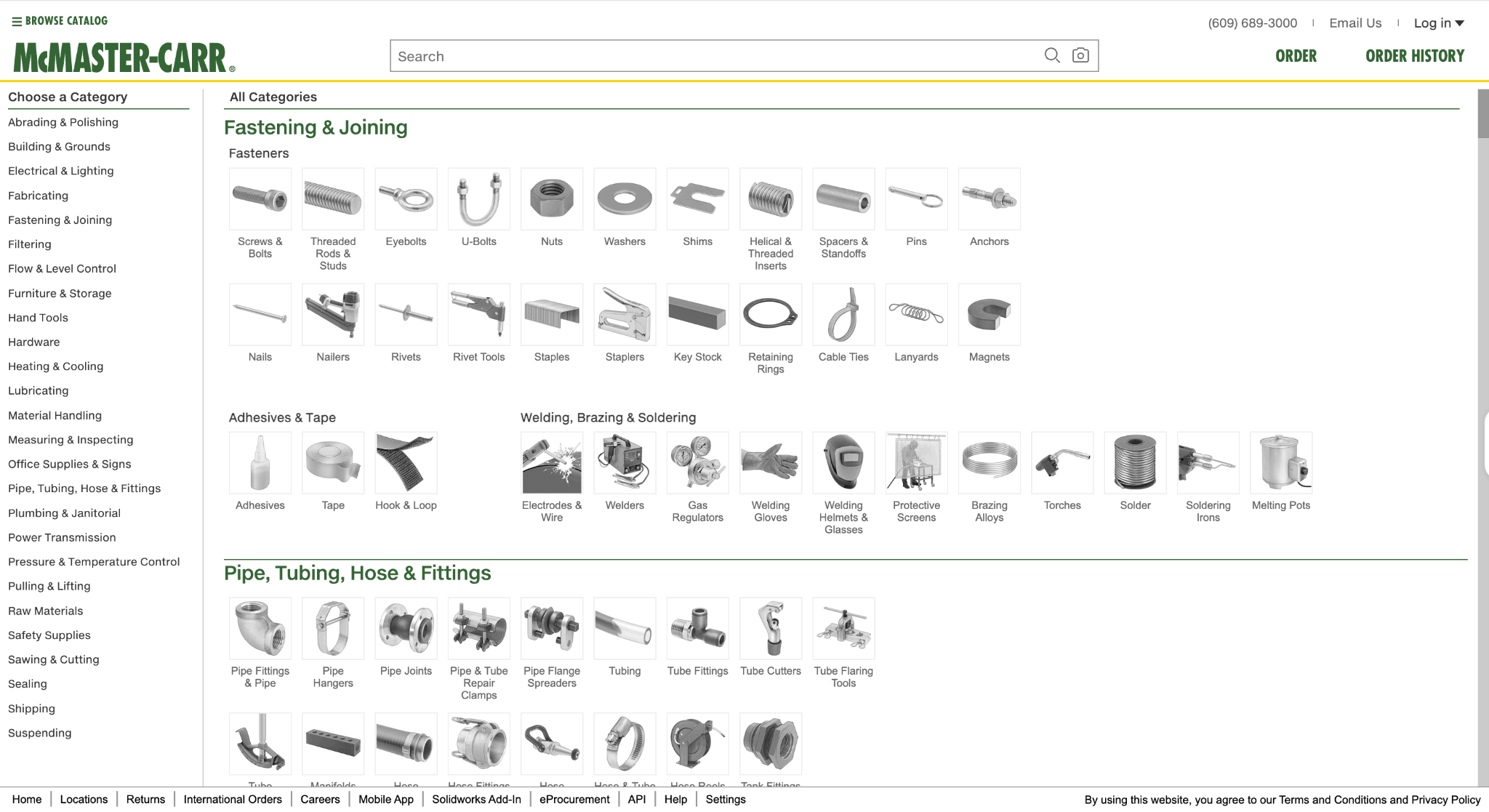
McMaster-Carr runs one of the widest-catalog industrial distributors available, with over 580,000 products and a fulfillment operation that ships 98% of orders from stock. Next-morning delivery is available for orders placed by 6 p.m. EST, with no order minimums and no restocking fees (which removes two of the most common friction points in industrial procurement). CAD model downloads directly from the product pages save engineering teams real time. Live customer service reps who actively work to source items outside the catalog push their usefulness well beyond a simple online store.
What Sets McMaster-Carr Apart for Industrial Supply Stores?
Procurement teams dealing with urgent maintenance needs or hard-to-find components under time pressure find that McMaster’s combination of catalog depth and next-day shipping solves problems that other distributors can’t. Their $1.3 billion revenue and recognition as a 2024 Campus Forward Award winner suggest a company that’s investing in the people and systems needed to sustain that kind of fulfillment performance.
What Users Are Actually Saying:
Buyers return to McMaster-Carr because the experience is consistently predictable: fast delivery, transparent pricing, and real humans available when something unusual comes up. That kind of reliability is rare at this catalog size. Users also flag the CAD model availability as a detail that other distributors skip but that saves meaningful time on the engineering side.
Methodology Behind These Picks
Gathering and Organizing Your Data Sources
The research process started by pulling a broad list of industrial supply companies from multiple channels, including industry directories, distributor listings, trade publication references, and manufacturer certification databases. Each source was logged to give a clear picture of which names appeared consistently across the market. Companies that showed up in multiple independent contexts moved forward into the evaluation pool, while those with thin or inconsistent online footprints were set aside early.
The Shortlist Cut
From the initial pool, each company was examined for verifiable information. Options with unverified claims, missing documentation, or review patterns that suggested inflated or inconsistent feedback were removed. Review data was analyzed for recurring themes rather than individual ratings, since a single outlier score tells you less than a pattern across dozens of responses. Only companies with consistent, documentable standing in the industrial supply space cleared this stage.
Fact-Checking the Picks
Claims made on each company’s website were checked against what third-party sources, case studies, and user reviews actually reported. When a company described a capability on their site, the research looked for external confirmation of that capability in action. Where website claims and real-world evidence matched up, those companies were kept. Where gaps or inconsistencies appeared between what was claimed and what could be independently confirmed, that was factored into the evaluation.
Authority Signals and Industry Standing
Each company’s standing in the broader market was assessed by looking at industry awards, mentions in trade publications, original research or technical documentation they had published, and professional certifications relevant to their area. A company that regularly appears in credible industry contexts carries a different weight than one that only surfaces in its own marketing materials. These authority signals were treated as supporting evidence rather than the only criterion, but they meaningfully differentiated companies with real market presence from those with less verifiable profiles.
Industrial Supply Stores Track Record
The final layer of review looked at each company’s documented work within the industrial supply space. This meant examining whether they maintained dedicated service or product pages relevant to industrial procurement, had verified reviews from industrial buyers, and could point to real-world case studies or deployment examples. Companies that demonstrated a track record specific to this market, rather than general distribution or manufacturing claims, earned higher confidence in their placement on this list.
Picking the Right Industrial Supply Stores for You
Choosing a supplier in this space comes down to more than who has the lowest unit price. The right fit depends on what your facility actually needs, how fast you need it, and how much technical support you expect from a vendor relationship.
- Industry/Domain Experience: Look for suppliers who work in your processing environment, whether that is sanitary food and beverage, pharmaceutical, HVAC, or compute cooling. General distributors can fill gaps, but specialists save you time on spec verification.
- Features and Service: Consider whether you need just parts, or whether you need fabrication, design support, or on-site service as well. Some suppliers cover the full chain; others don’t.
- Pricing Structure: Understand the total cost of ownership, not just the unit price. Lead times, minimum orders, restocking fees, and shipping costs all affect what a vendor actually costs your operation.
- Results Measurement: Ask how a supplier tracks and reports on order fulfillment rate, fill rate, and on-time delivery. Reliable data from your supplier makes your procurement reporting easier to defend.
- Industry Knowledge and Compliance: For regulated industries, your supplier needs to understand OSHA, ANSI, ISO, and ASME-BPE standards. A part that doesn’t meet the right spec creates liability that shows up far downstream from the purchase order.
The Verdict
The right industrial supply store depends almost entirely on what your facility processes and how specialized your needs are. CSI Store leads for sanitary processing and fabrication. McMaster-Carr wins on speed and catalog breadth. Daikin Applied and Schneider Electric are the calls for HVAC and energy management at scale. CoolIT handles the compute cooling edge. As AI infrastructure and regulated manufacturing keep growing, suppliers who combine technical depth with fast fulfillment will pull further ahead.