Residential construction projects rarely fall behind because of one catastrophic event. More often, delays build slowly through missed deliveries, equipment failures, poor communication, and small maintenance problems that spiral into expensive downtime.
For contractors, every idle hour affects labor schedules, subcontractor coordination, and profit margins. For homeowners, delays create frustration, extended disruptions, and rising project costs. A stalled grading crew can delay framing. A broken skid steer can push back concrete work. One overlooked hydraulic leak can create a chain reaction across an entire residential build schedule.
That is why successful contractors treat downtime prevention as part of project management, not just equipment maintenance. Coordination, scheduling, and communication keep residential jobs moving, but reliable machinery keeps crews productive enough to stay on schedule.
To stop site delays and reduce equipment downtime, crews must implement daily walkarounds and standardized greasing schedules. They also need curated on-site spares kits and paper-in-glovebox parts identification protocols. These manual heavy machinery maintenance habits prevent minor hydraulic leaks and wear point deterioration from escalating.
By replacing vague maintenance assumptions with specific accountability systems, contractors can predictably keep heavy machinery running.
It is dawn on a critical grading job when the skid steer suddenly lets out a metallic groan. Amber fluid begins spreading across the freshly graded subgrade, forcing the crew to stand idle while the clock burns a margin.
A sudden silence on the job site is a major financial event. In fact, preventable losses across industries recently totaled billions, with massive amounts due to downtime alone.
Dashboards and sophisticated telematics rarely catch what a trained eye notices at dawn. Establishments relying heavily on reactive maintenance suffer drastically more downtime than proactive crews.
The reasons why projects slow down are often manual, low-tech, and stubbornly human.
Maintaining a ready stock of essential backhoe parts sourced through distributors such as HW Part Store, alongside standard hydraulic fluid and heavy-duty grease tubes, separates the crews that lose days from those that lose hours.

Why Downtime Hurts Residential Construction Projects
In residential construction, timelines are tightly connected. Excavation affects foundations. Foundations affect framing. Framing affects every trade that follows. When one machine goes down unexpectedly, the impact spreads across the entire schedule.
Contractors often absorb the first wave of financial pain through idle labor costs, rushed rentals, emergency repair fees, and disrupted subcontractor schedules. Homeowners feel the effects through delayed move-in dates, extended noise and disruption, and budget uncertainty.
Even short delays can damage client trust. Homeowners expect communication, predictability, and visible progress. Contractors who maintain equipment reliability and organize workflows effectively are far more likely to keep projects on track and maintain strong customer relationships.
The best-performing residential crews understand that downtime prevention starts long before a machine fails. It starts with disciplined habits, clear accountability, and proactive maintenance systems.
1. The Ten Minute Coffee Cup Walkaround
Alt: Worker examines machinery at sunrise, holding a coffee mug
This daily inspection is executed while the coffee is still hot, before a wrench is touched or a key is turned. Hydraulic systems rarely fail without warning because they bleed slowly and whine faintly before failing.
A dedicated walkaround catches those signals early. Start by squatting to check the cylinder rods.
A glistening rod is a weeping seal, not lubrication. Left alone, that seep becomes a pressurized stream under load. Next, scan the belly pans and undercarriage. Pooled fluid under a machine at start-up indicates a fundamentally different problem than fluid pooling after a long shift.
For suspected hose runs, use the cardboard hose-spray test. Hold a piece of cardboard near the suspected leak area to check. Atomized hydraulic spray under pressure is often invisible to the naked eye but leaves a clear stain on cardboard.
This real-world field trick saves pumps and prevents serious injection injuries.
Finally, check breather caps and return filter indicators. A bypassing return filter is a contamination event waiting to happen. Always check the pop-up indicator before assuming the hydraulic system is clean.
Catching a loose fitting at dawn is the difference between a ten-minute fix and a half-day emergency sourcing event.
2. Standardizing the Set and Forget Grease Schedule
The most expensive phrase on any active job site is the assumption that someone else already greased the machine. When wear points run dry, the physical results are immediate and destructive.
Metal-to-metal contact occurs, bores go egg-shaped, and structural loading shifts entirely to the pins themselves. This avoids the bushings designed to absorb the force.
Assign a specific person to the task, not a general crew expectation. Diffuse responsibility is no responsibility at all. Grease schedules assigned to a named, accountable operator actually get done.
Standardize the grease type fleet-wide to prevent chemical reactions that degrade lubrication properties.
Eliminate all excuses by keeping a wear point map in the cab. A laminated sheet showing every Zerk fitting location ensures comprehensive wear point inspection. Cadence also requires absolute specificity.
For example, mini skid steers operating in sandy or muddy conditions require bucket pivot pin greasing every eight operating hours.
A single bucket pivot pin replacement routinely runs into the hundreds of dollars. Scale that across a grading season, and the parts manifest tells a familiar story.
High turnover components would easily last another season or two with a consistent schedule behind them. The grease gun remains the absolute cheapest insurance policy on the job site.
3. The Simple On-Site Spares Kit
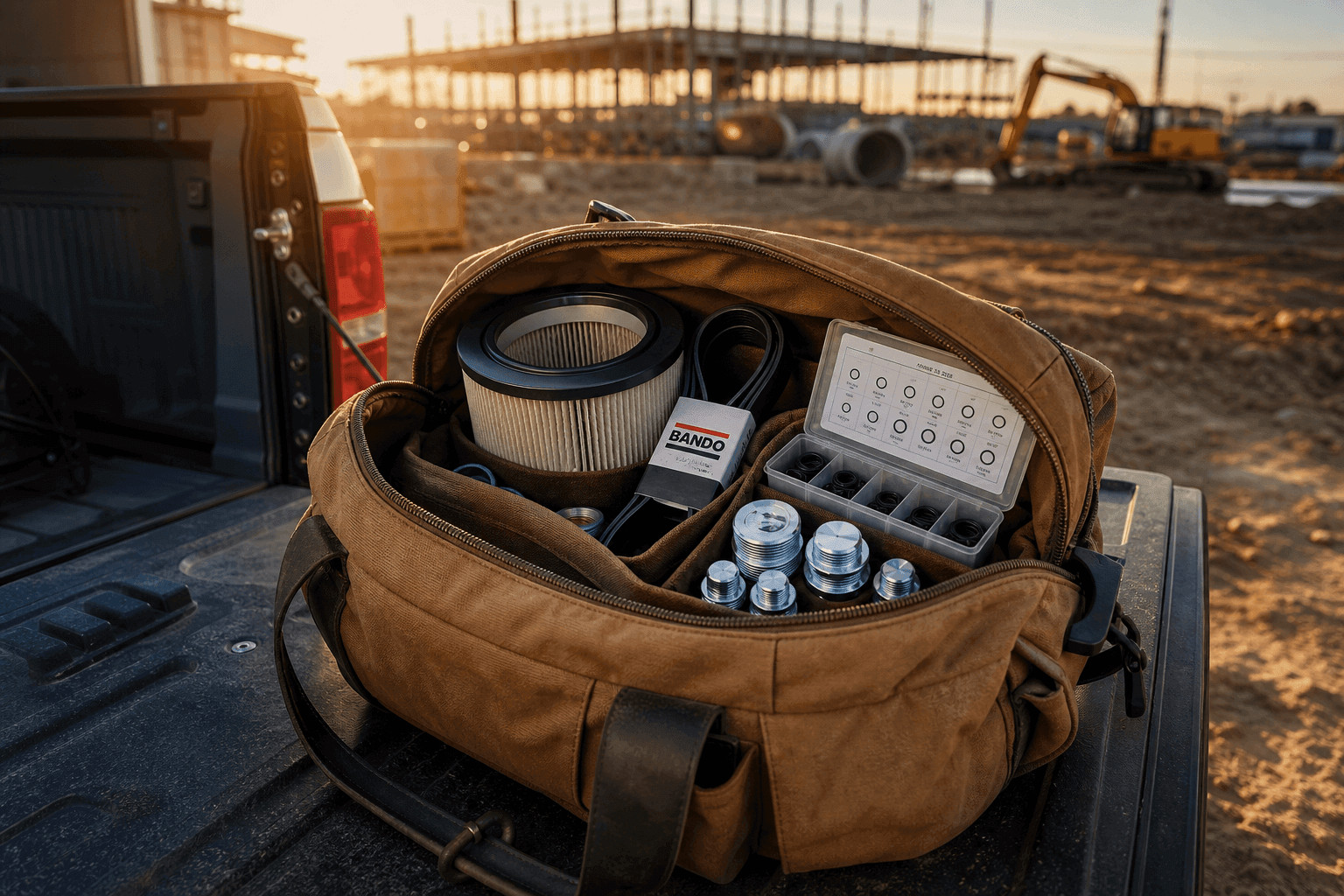
Breakdowns are inevitably going to happen on any active job site, but multi-day delays are a choice. A curated on-site spares kit is the operational solution to Friday afternoon equipment failures.
Instead of hoarding random spare parts, strategically curate the statistically common failure points for your specific fleet.
For skid steers and excavators running high-flow attachments, a blown coupler O-ring at the auxiliary circuit is a common failure. Having a cheap replacement in the bag is infinitely better than making a panicked emergency sourcing call on a weekend.
Next, stock exactly one engine air filter and serpentine belt per machine type. Dusty grading and demolition environments eat air filters rapidly.
A clogged filter at the wrong moment shuts down a machine that has absolutely nothing hydraulically wrong with it. Keep them staged and ready.
Finally, carry proper caps and plugs for blown hose scenarios. When a hose lets go, the immediate priority is plugging the open bulkhead port to prevent fluid loss and system contamination.
Stuffing a dirty shop rag into an open hydraulic port is a very expensive workaround still seen in the field. A dirty rag introduces microscopic debris that ruins components upon startup. Proper steel caps cost less than a dollar each and protect the entire hydraulic system.
Important: Never plug an open hydraulic port with a dirty shop rag. Microscopic debris introduced this way guarantees a pump damage event on startup. Use proper steel caps because they cost less than a dollar each.
4. The Paper in Glovebox Parts ID Protocol
Searching for a model number routinely costs an hour of idle time before a single wrench is even turned. The data plate is often rubbed out, forcing the crew to stand around while one person scrapes paint in the field.
Implementing a printed binder eliminates this frustrating research phase. This binder lives in the truck door or the cab console.
It contains a single cheat sheet per machine listing the exact make, model, and full serial number. It also includes the serial number break notation that determines which specific replacement components apply.
Serial number breaks matter immensely. Guessing wrong costs an entire day of production.
Establish a strict pre-repair protocol. Before unbolting anything, photograph the machine data plate. Cross-reference the serial number break chart, and place the parts order before the machine is fully disassembled.
Finally, document the disassembly configuration in the binder for the next rebuild.
To accelerate the process, add a laminated card listing high turnover component numbers for each machine. Include throttle cables, boom seal kits, bucket teeth, stabilizer seals, and return filter elements.
Reorders become a rapid phone call or website visit with exact numbers already in hand.
Key Insight: A one-digit difference in a serial number break can turn a seal kit order into a full day of downtime. A binder cheat sheet with exact model and serial numbers eliminates costly guesswork and parts returns.
Communication and Scheduling Keep Crews Productive
Equipment reliability alone will not keep a residential project moving. Contractors also need strong coordination between field crews, subcontractors, suppliers, and homeowners.
Clear scheduling prevents trades from stacking on top of one another. Daily communication helps identify delays before they become larger problems. Simple check-ins with crews and homeowners reduce confusion and improve accountability across the project.
When equipment maintenance, scheduling discipline, and communication systems work together, contractors create predictable workflows that reduce costly interruptions.
That consistency matters on residential projects where homeowners are closely watching timelines, budgets, and visible progress.
Putting It All Together
Cutting downtime is about practical accountability. A manila envelope in the cab, a laminated card on the dash, and a visual walkaround completed before the throttle opens make all the difference.
These four habits are mutually reinforcing, each shortening the gap between a mechanical breakdown and getting back to work. You can build a downtime binder tonight using three simple sections.
Section 1 is the daily inspection sheet, requiring operator initials to confirm that leaks, levels, and lights are checked.
Section 2 is the service intervals chart, mapping greasing cadences, filter changes, and fluid sampling schedules to precise operating hours.
Section 3 is the parts manifest, housing machine IDs, serial number breaks, and exact component numbers for high-wear items.
Safety must always remain paramount during these checks.
Always lock out the boom before any cylinder or hose work begins. Relieve stored pressure in accumulators before opening any hydraulic circuits, and heavily respect the stored energy in extended cylinders.
Safety failures are devastating, and heavy machinery maintenance activities account for numerous severe workplace injuries across industrial sectors. These risks underscore why organized protocols are essential.
When the binder is built and the parts manifest is fully populated, the final variable is fulfillment. Finding a reliable parts source that ships the correct component the same day it is ordered avoids exorbitant dealer markups.
That reliable sourcing makes all four manual habits worth the daily effort. Implement these systems, build the binder, and stop paying for the heavy silence of idle machinery.
Author Profile: HW Part Store is the leading online retailer of aftermarket hydraulic cylinder seal kits, replacement parts and attachments for a wide range of industrial construction equipment.