Adults experience a move as a project. Kids experience it as the only home they remember being taken apart and driven away. The difference between a move kids handle well and one that produces weeks of rough bedtimes usually isn’t the distance or the house, it’s how the two weeks around moving day get run.
Tell them early, and match the message to the age
The instinct to delay the news “until things are certain” backfires kids’ sense of packing long before they’re told what it means. Toddlers need simple and concrete (“we’re taking all your toys to the new house”). School-age kids need the answers to their real questions: Do I change schools? Can my friends visit? Teens need something different to input. Let a teenager have real say over their new room, and the move stops being purely something happening to them.
Give every kid a “first night” box they pack themselves
One box per child, packed by the child: favorite stuffed animal, pajamas, night light, the bedtime book, tomorrow’s clothes. It rides in the car, never the truck. The point isn’t just logistics. It’s that the child watched their most important possessions stay within reach the entire day. For the parents’ version, add sheets, towels, chargers, and coffee, because the first night works the same way for everyone.
Moving day: little kids off-site, big kids on the roster
Under about age six, the answer is the same one that applies to pets: somewhere else, grandparents, a trusted friend, a normal daycare day. Crews are moving heavy furniture fast through propped-open doors; a toddler underfoot is a genuine safety issue, and a stressful day for the toddler anyway. Kids old enough to help should get real jobs with titles: labeling their own boxes, checking rooms one last time, being the official water-bottle runner. Being useful beats being managed.
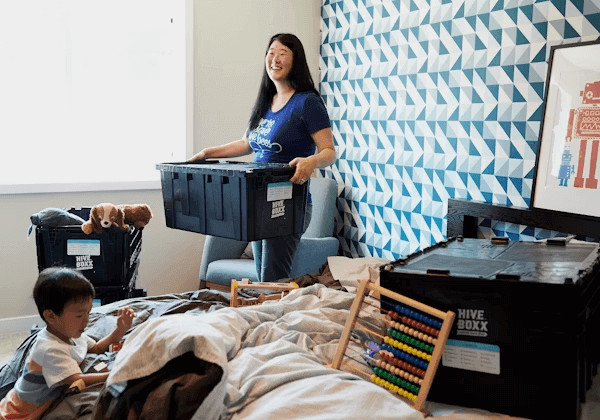
Set up the kids’ rooms first — before your own, before the kitchen
The fastest way to make a strange house feel safe is a bedroom that looks right by bedtime: bed assembled, familiar sheets, curtains up, favorite things visible. Everything else can live in boxes for a week. And hold the bedtime routine steady the very first night same book, same order, same time. Routine is portable even when nothing else is.
Expect the dip in week two, not day two
Most kids run on excitement through the move itself. The wobble comes later, when the novelty fades and the missing-friends part gets real clinginess in little ones, moodiness in bigger ones, a few regressions that had been long outgrown. It’s normal decompression, and it passes faster with two things: quick reconnection to activities (the same sport or class they had before, restarted within a couple of weeks) and patience with the backslide. What lingers past a month or two is a conversation for the pediatrician, but it rarely gets there.
The timing question: summer move or mid-year?
Summer is logistically easier and gives kids a runway but it also means weeks in a new place with no built-in way to meet anyone until school starts. A mid-year move drops a child straight into a classroom where the fastest friendships form. There’s no universally right answer, but don’t assume summer wins by default; for socially motivated kids, arriving three weeks before the semester starts is often the sweet spot.
What the crews see
“You can tell within five minutes which families made a plan for the kids the house has a rhythm instead of a panic,” says Elle Nesher, co-owner of Element Moving & Storage, one of the busiest moving companies in Dallas, with roughly 200 moves a month across the metroplex. “The best move I’ve seen a parent make is the job title trick. We had a six-year-old ‘inventory manager’ checking off boxes on a clipboard as they came off the truck. He talked about that day for a year, and his mom got to actually direct the unload.”
FAQ
Should kids be there on moving day? Under six: ideally no arrange care off-site. Six and up: yes, with an actual job. The worst option is a bored child told to “stay out of the way” for eight hours.
How do I transfer school records in a local move? Request records from the current school once enrollment is confirmed; most districts transfer directly between schools. Enroll as early as the new district allows waiting until arrival week can cost days of class time.
What about moving during the school year? It’s more workable than its reputation. Teachers routinely fold in mid-year arrivals, and classmates are a ready-made social circuit. Coordinate the start date so the first day isn’t also unpacking day.
How long until kids feel settled? Most find a new normal in four to six weeks faster when their room went up first, activities restarted quickly, and the old friends stayed reachable by video call rather than being quietly dropped.