Most job site injuries don’t stem from equipment failures. Workers get hurt because there’s inadequate separation between them and live traffic, zones aren’t marked properly, and barriers shift or topple when pressure hits them.
Residential construction projects often happen in active neighborhoods, busy streets, and shared community spaces where safety matters just as much as productivity. Whether crews are building a new home, remodeling a driveway, or working on utility upgrades in a subdivision, keeping workers, equipment, and nearby traffic separated is critical.
Concrete safety barriers help create clear boundaries that protect crews and reduce confusion around active work zones. Unlike cones or lightweight plastic barriers, they stay in place under pressure and provide reliable protection in areas where vehicles and pedestrians move close to the job site.
These advantages go far beyond just ticking off compliance boxes. Here’s why experienced project managers keep coming back to them.
1. They Create a Physical Line That Traffic Can’t Cross
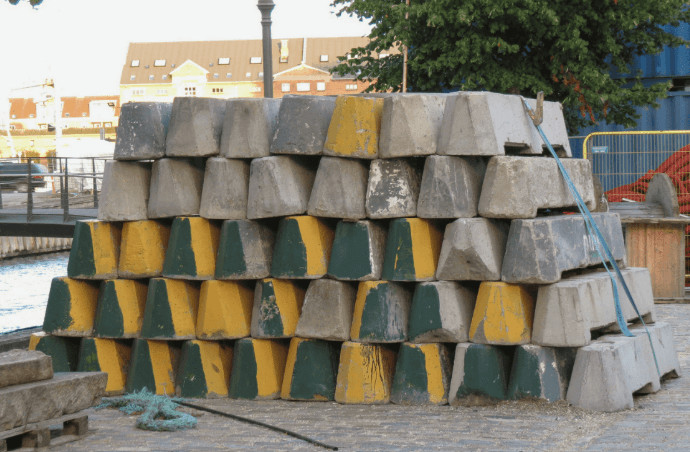
Traffic and site control barriers by 48 Barriers are designed for active conditions where cones or plastic water-filled units are inadequate. These barriers, such as Jersey barriers or K-rail sections, weigh between 2,000 and 4,000 pounds, preventing errant vehicles from moving them on impact.
They halt vehicles immediately, outperforming signage and delineator posts, especially at 35 mph. A vehicle hitting a concrete barrier will be redirected, keeping your crew safe. According to OSHA’s 29 CFR 1926 Subpart G, concrete barriers meet or surpass traffic control standards, providing passive protection without requiring workers to be near hazards.
2. They Define Work Zones with Precision
Concrete barriers do more than stop vehicles. They create a clear physical boundary that shows exactly where work begins and ends. That helps reduce confusion for workers, drivers, and pedestrians nearby.
On residential projects, this matters even more. A driveway replacement, utility repair, or home addition often happens just a few feet from active streets and sidewalks. Barriers help keep neighbors, delivery drivers, and passing traffic away from equipment and work areas.
Sites with clearly marked zones tend to have fewer close calls because everyone understands where it is safe to move. Workers know their protected space, and inspectors can quickly confirm the setup matches the traffic control plan.
Barrier sections can also be arranged in curves, corners, or straight lines to match almost any layout. Whether crews are working around a cul-de-sac, neighborhood intersection, or narrow residential lane, concrete barriers can adapt to the space.
3. Concrete Barriers Protect Workers from High-Speed Impact
Concrete safety barriers are designed to absorb and redirect impact instead of collapsing or sliding out of place. Their weight and shape help push vehicles away from active work zones, reducing the chance of serious injuries.
This is one reason Jersey barriers and K-rails are commonly used in road construction and residential utility work. According to the Bureau of Labor Statistics, struck-by incidents remain one of the leading causes of construction fatalities each year.
For residential projects near open streets, barriers provide an added layer of protection for crews working close to moving traffic. That includes paving contractors resurfacing neighborhood roads, utility teams repairing underground lines, or crews installing sidewalks in active subdivisions.
Plastic barriers can work for lighter-duty setups, but they are more likely to shift, crack, or tip during impact. Concrete barriers hold their position better and require less maintenance over the course of a project.
4. They Cut Long-Term Site Costs
Renting concrete barriers costs more upfront than plastic options. But over a multi-week or multi-month project, the math changes. Concrete barriers don’t need replacement after a minor impact. They won’t split, crack, or leak when temperatures plummet; you don’t need crews repositioning them every time wind picks up, either.
A typical plastic water-filled barrier runs about $150, $300 per unit to rent monthly. Concrete K-rails often cost a comparable amount per unit; they handle wind, weather, and low-speed impacts without follow-up labor or replacement costs. On a 90-day project with 100 barrier units, those maintenance hours add up quickly.
Here’s the thing: you spec concrete once, and you’re finished. No damage reports. No emergency replacement orders mid-project. No productivity loss because your barrier perimeter got compromised overnight.
5. They Work for Nearly Every Job Site Type
Concrete safety barriers aren’t limited to highway lane closures. The same advantages apply whether you’re running utility installation in a commercial parking lot, replacing a bridge deck on an interstate, or setting up perimeter security at a government facility.
Construction contractors use them to separate equipment staging areas from pedestrian zones. Event producers place them at entry points to protect crowds from vehicle intrusions. Energy companies drop them around substations and wellhead facilities. Parking operators use them to define permanent or seasonal lane configurations.
And because barrier sections are modular, crews can deploy, reposition, or remove them without specialized equipment in most cases. A standard barrier lift handles most sections. That speed of reconfiguration is something fixed guardrails and permanent curbing simply can’t provide.
Conclusion
The 5 advantages of using concrete safety barriers on active job sites boil down to mass, geometry, and practicality. They stop vehicles that nothing lighter can stop. They define work zones without guesswork.
They protect workers from struck-by injuries, a leading cause of construction fatalities. They hold up better than lightweight alternatives so you save money across your project’s timeline. And they adapt to nearly any site condition you’ll face.
From neighborhood roadwork and driveway replacements to new home construction and utility upgrades, concrete barriers give contractors a dependable way to manage traffic and improve site safety. For residential projects where crews work close to streets, sidewalks, and homeowners, they remain one of the most practical traffic control solutions available.