Steel and glass partitions carry a strong visual identity. The combination of dark metal profiles and clear glass panels immediately suggests industrial lofts, converted warehouses, and the bold interiors that defined urban residential design in cities like New York and Chicago. That association is partly why they became so popular, but it is also what makes some people hesitate to consider them for spaces that do not already lean industrial.
The hesitation is understandable but not really warranted. When the design variables are handled thoughtfully, a steel glass partition can work in a Scandinavian minimalist apartment, a French country kitchen, a traditional townhouse, a contemporary beach house, or a modern farmhouse. The key is knowing which variables to adjust and how to adjust them.
Understanding the Design Variables
Steel glass partitions are not a single product. They are a system with several components, and each component can be specified in different ways. Understanding what those components are and how they affect the overall look is the starting point for good design decisions.
Frame Profile Width and Shape
The width of the steel profile has a significant effect on the visual character of the partition. Narrow profiles feel refined and architectural. They make the glass the primary element and push the frame into the background. Heavier profiles read differently depending on context: in an industrial space they feel appropriate, even structural; in a more refined setting they can read as raw or unfinished.
Quality custom steel glass partitions manufacturers use hand-welding techniques to achieve thinner profiles than factory-produced alternatives can typically match. Thinner frames mean more glass, which means more light and a cleaner visual outcome. If you are placing a steel partition in a space where you want the architecture to feel intentional rather than utilitarian, the profile width is one of the first things to get right.
Finish and Color
The surface finish on the steel frame is one of the most powerful tools available for adapting the partition to its surroundings. The same structural system can read in completely different ways depending on how the metal is treated.
• Matte black is the most common choice and suits contemporary, minimalist, and industrial spaces well. In traditional spaces, it can also work because it reads like classic ironwork rather than modern metalwork.
• Raw or lightly treated steel has an authentic, artisanal quality that suits loft conversions and spaces where texture and material honesty are deliberate design choices.
• White or off-white finishes soften the metal frame considerably and make the partition feel lighter and less assertive. This is a strong choice for Scandinavian interiors or any space where the partition should recede rather than assert itself.
• Warm metal tones such as bronze, aged brass, or copper have become increasingly popular in transitional and traditional interiors. These finishes pair well with wood, natural stone, and linen, and they give the partition a warmth that cooler finishes do not.
Glass Type and Opacity
The glass itself carries as much design weight as the frame. Choosing the right type for your space and your privacy requirements shapes how the finished partition performs both visually and functionally.
• Clear glass is the default choice for spaces where visual connection and light transmission are priorities. It works well in open office environments and in residential spaces where the partition defines a zone without blocking the view.
• Frosted or acid-etched glass diffuses light while obscuring the view. It is the right choice for spaces where some visual privacy is needed, such as a home office that opens onto a living room or a meeting room in a commercial setting.
• Tinted glass in bronze, grey, or green tones can complement specific color palettes and add a layer of character to the partition. It also reduces glare, which matters in south-facing rooms.
• Fluted or reeded glass adds visual texture without fully blocking the view. It has become very popular in residential interiors where the partition doubles as a design feature in its own right.
Hardware and Door Design
The hardware on a steel glass partition, the hinges, handles, and door configuration, contributes significantly to how the partition reads in the room. Heavy industrial hardware in a dark finish reinforces the raw aesthetic. Minimal, precision-machined hardware in a matching finish keeps things refined. Choosing hardware that is coherent with the frame finish and the overall interior style is worth more attention than it often gets.
Matching Steel Glass Partitions to Specific Design Styles
Industrial and Loft
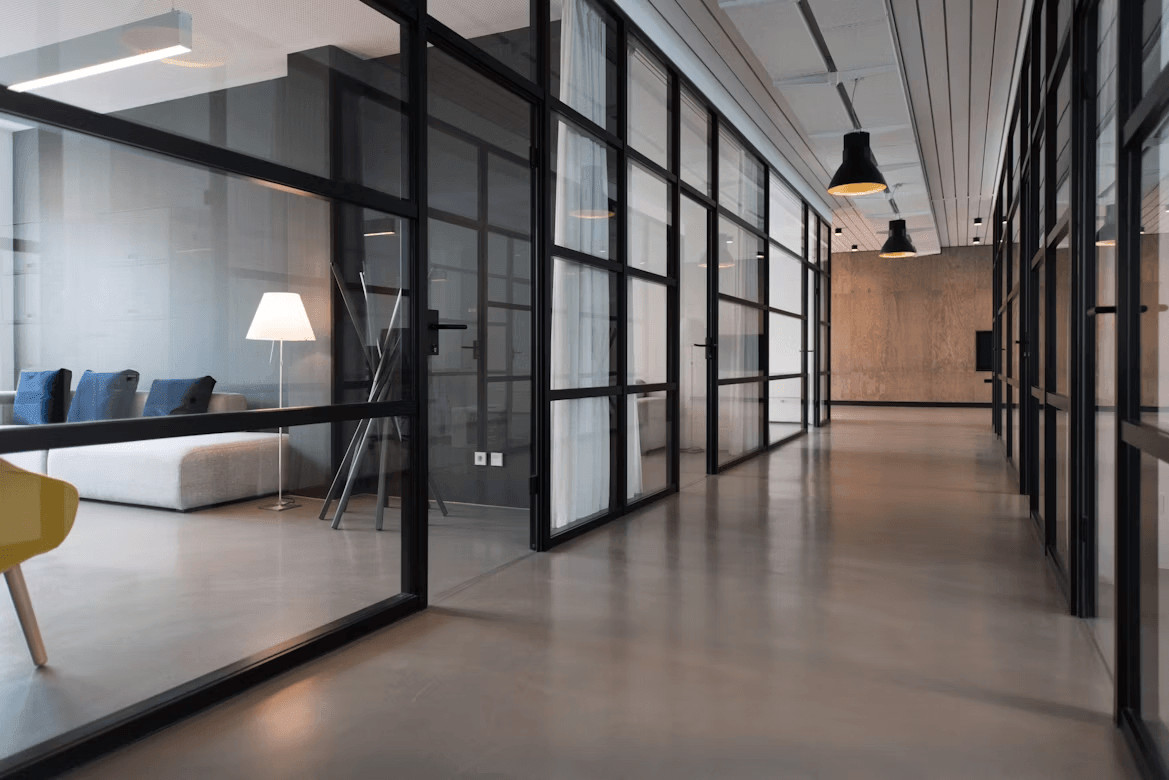
Industrial is where steel and glass partitions are most at home. Exposed ductwork, polished concrete floors, reclaimed wood, and brick walls all coexist naturally with a grid-pattern steel partition in matte black or raw steel. The partition feels like part of the architecture rather than an addition to it. In this context, you can lean into heavier profiles and more visible welds because they reinforce the material honesty that defines the style.
Modern and Contemporary
For clean contemporary interiors, the goal is precision. Use the thinnest available profiles in matte black or dark grey. Keep the glass clear and uninterrupted. Hardware should be geometric and minimal. The partition should read as a considered architectural element rather than a decorative one, and it should not compete with other design features in the room.
Transitional
Transitional interiors blend traditional and contemporary elements, and steel glass partitions in warm metal finishes bridge that gap effectively. A bronze or aged brass frame with clear glass reads as current without feeling cold. Pair it with wood accents, upholstered furniture in natural textiles, and a warm neutral palette and the partition will feel integrated rather than incongruous.
Scandinavian and Minimalist
In a Scandinavian or minimalist interior, the partition should function as a background element. A white or light grey frame finish reduces the visual weight of the metal. Clear glass keeps the space open. Hardware should be as simple as possible. The goal is a partition that defines space without making a statement about itself.
Traditional and Classic
Steel and glass might seem like an unusual choice for a traditional interior, but the combination can work beautifully when the frame finish echoes the metalwork details found in traditional architecture. A matte black grid partition in a Victorian townhouse reads like the iron railings and window frames that were already part of the building. Pair it with warm wood floors, traditional furniture, and period-appropriate fixtures and the partition will feel historically coherent rather than anachronistic.
The Role of Custom Fabrication
All of the design flexibility described above depends on working with a manufacturer who actually builds to your specifications rather than selling you a standard product in a limited range of finishes. Custom steel glass partitions, like those available through Crystalia Glass, are fabricated to the exact dimensions of your space with the frame finish, glass type, and hardware specified for your project.
Practical Considerations Before You Specify
A few things are worth thinking through before you commit to a steel glass partition in any space.
• Ceiling and floor connections: The detail at the top and bottom of the frame significantly affects the quality of the finished look. Ask your installer how they handle uneven ceilings and whether the base sits flush to the floor.
• Door placement and swing: The location of the door opening and the direction of the swing affects both the aesthetics and the daily usability of the partition. Think through how traffic moves through the space before fixing the door position.
• Lighting conditions: Natural light through a glass partition changes throughout the day. Consider how the partition will read in morning light, afternoon light, and artificial light at night. This affects which glass type and frame finish will work best.
• Acoustic expectations: Steel and glass partitions reduce sound transmission but do not eliminate it. If acoustic performance is a significant requirement, discuss glass thickness and panel sealing options with your fabricator before the design is finalized.
Steel glass partitions are among the most versatile interior architectural elements available to designers and homeowners today. With the right attention to the variables described here, they can support nearly any design language while adding a level of permanence and considered quality that manufactured partition systems rarely achieve.
Working With a Designer vs. Specifying Directly
Some homeowners and commercial clients choose to work with an interior designer or architect who specifies the partition as part of a broader design project. Others go directly to the manufacturer. Both approaches can produce excellent results, but they have different implications.
Working with a designer gives you a professional who understands how the partition fits into the larger interior context. They will have opinions about frame finish, glass type, and hardware that are grounded in the overall design direction. They will also coordinate with other trades, which reduces the burden on the client. The tradeoff is an additional layer of cost and the need to find a designer whose aesthetic aligns with yours.
Going directly to the manufacturer gives you more direct control over the specification and usually a shorter line of communication when decisions need to be made. Manufacturers like Crystalia Glass have design consultants who can guide clients through the options in a way that is informed by production reality, meaning they can tell you what is actually buildable at a given price point rather than specifying something that turns out to be impractical.
For complex projects with multiple trades and a tight design brief, a designer adds real value. For a single-room partition in a residential setting where the design direction is already clear, going directly to the manufacturer is often the more efficient path.
One practical note regardless of which route you choose: bring your frame finish and glass type decisions to the table before you get into detailed pricing. These two variables affect cost more than almost anything else in the specification, and locking them in early prevents the project from going back and forth as the design evolves.