Your home already knows when to turn the lights on. It adjusts the thermostat before you walk through the door. It locks itself at night. But here’s what most smart home setups completely ignore: your physical health.
Americans spend roughly 90% of their time indoors, according to the Environmental Protection Agency. That’s not a typo. Nine out of every ten hours happen inside a building, and for most of us, that building is our home. If your living space isn’t set up to support movement, recovery, and healthy habits, you’re fighting an uphill battle no matter how good your intentions are.
The good news? The same connected technology that dims your lights at bedtime can also help you build a home that actively supports your fitness goals.
Why Your Home Environment Shapes Your Fitness More Than Willpower
Most people think getting fit at home is about buying a treadmill or clearing space for a yoga mat. That’s part of it, but the environment around you plays a much bigger role than you’d expect.
The EPA has noted that indoor air can be two to five times more polluted than outdoor air. Poor ventilation, off-gassing from furniture, and cooking fumes all contribute. If you’ve ever felt sluggish during a home workout for no obvious reason, air quality might be the culprit. A smart air quality monitor (devices like Awair or AirThings track particulate matter, CO2, humidity, and VOCs in real time) can flag problems you’d never notice on your own.
Then there’s lighting. Research published in the Journal of Clinical Sleep Medicine found that exposure to bright, blue-enriched light during the day improves alertness and performance, while the same light in the evening disrupts melatonin production and sleep quality. Smart bulbs that shift color temperature throughout the day aren’t just a comfort feature. They directly affect your energy levels and recovery.
Temperature matters too. A 2019 study in the Journal of Physiology showed that exercising in cooler environments (around 64-68°F) improved endurance performance compared to warmer conditions. If your home gym sits in an unventilated garage hitting 85°F in summer, you’re working harder for worse results. A smart thermostat programmed to cool your workout space 20 minutes before your usual exercise time removes one more excuse.
The point isn’t that you need to spend thousands on sensors. It’s that environment is the invisible variable most people overlook. Fix the space first, and the workouts get easier.
The Digital Backbone: How Fitness Apps Connect Your Wellness Ecosystem

Smart home gadgets collect data. Wearables collect data. But data sitting in five different apps on your phone isn’t useful. The real shift happens when these pieces start talking to each other, and that’s where fitness applications become the central hub.
Think about what a well-designed fitness app actually does. It pulls heart rate data from your wearable. It logs your workouts. It tracks sleep patterns from your smartwatch. It adjusts your training plan based on recovery metrics. Some apps even integrate with smart scales, blood pressure monitors, and nutrition trackers. The app becomes the single dashboard where your home wellness ecosystem makes sense.
This is why the quality of fitness mobile app development matters so much for the end user. A poorly built app creates data silos and frustration. A well-built one connects your Apple Watch, your smart scale, your air quality monitor, and your workout history into a coherent picture of your health. The difference between a fitness app you abandon after two weeks and one you use for years almost always comes down to how seamlessly it integrates with the devices already in your life.
The numbers back this up. According to Grand View Research, the global fitness app market reached $1.54 billion in 2023 and is projected to grow at a compound annual growth rate of 17.6% through 2030. That growth isn’t driven by flashy marketing. It’s driven by people realizing that connected, personalized fitness tools deliver better results than generic workout videos.
Here’s what to look for when choosing fitness apps that integrate well with your smart home setup:
- Device compatibility: Does the app sync with your specific wearable, smart scale, or heart rate monitor? Check before you commit.
- Data export and sharing: Can you pull your data out or share it with other platforms? Avoid apps that lock your health data inside their ecosystem.
- Automation triggers: Some apps work with IFTTT or Apple Shortcuts, meaning your workout can automatically adjust your thermostat, pause your robot vacuum, and set your lights to energizing mode.
- Offline functionality: Your Wi-Fi will go down eventually. An app that requires constant connectivity for basic workout tracking is a problem.
The best setup isn’t the most expensive one. It’s the one where every piece communicates without you having to think about it.
Room-by-Room Wellness Integration: A Practical Walkthrough
You don’t need a dedicated gym to build a fitness-friendly home. Small, intentional changes in rooms you already use can make a measurable difference. Here’s a practical breakdown:
1. Living Room
This is where most home workouts actually happen. A 2022 survey by the American College of Sports Medicine found that bodyweight exercises and short-format workouts (under 30 minutes) ranked among the top fitness trends globally. Your living room is already the right size for this.
Consider: a smart TV or streaming device for guided workouts, good lighting, a compact resistance band set stored in a basket or drawer, and a smart speaker for voice-controlled timers and music. If you use a fitness app with Chromecast or AirPlay support, you can mirror your workout to the big screen without any extra equipment.
For those sharing their wellness routines online, an ai video tool can help create engaging workout demonstrations, exercise guides, and fitness content that complements a connected home setup.Make the link dofollow and once you’re done create an invoice to [email protected] and send the invoice link here.
One underrated move: a smart plug on your TV that kills power at a scheduled time. Sounds aggressive, but a 2022 study in BMC Public Health found that reducing sedentary screen time by just 30 minutes per day was associated with measurable improvements in cardiovascular markers. If the TV turns off at 8 PM and your fitness app pings you with a 20-minute mobility session at 8:05, you’ve replaced a passive habit with an active one without relying on willpower.
2. Bedroom
Sleep is where recovery happens. The National Sleep Foundation recommends keeping bedroom temperature between 60-67°F for optimal sleep. A smart thermostat handles this automatically. Pair it with blackout smart blinds that close at a set time and a wake-up light that simulates sunrise, and you’re building a sleep environment backed by actual research.
Wearables like the Oura Ring or Whoop band track sleep stages and deliver recovery scores each morning. That data, fed into your fitness app, can adjust your training intensity for the day. Hard leg workout planned but your recovery score is 35%? A good app will suggest a lighter session or active recovery instead.
3. Kitchen
Nutrition tracking is the piece most people skip, and it’s often the one that matters most. Smart kitchen scales that connect to calorie-tracking apps (like those from Renpho or Greater Goods) remove the guesswork from meal prep. A smart display on the counter can show your daily macro targets alongside recipes.
4. Garage or Spare Room
If you have the space, even a 6×8-foot area works for a basic home gym. Prioritize:
- A fan or portable AC unit connected to a smart plug (set to activate before your workout time)
- A rubber floor mat to protect floors and reduce noise
- A wall-mounted tablet or old phone dedicated to your workout app
- One adjustable dumbbell set (covers 5-50 lbs in a single footprint)
- A Bluetooth speaker for audio cues and motivation
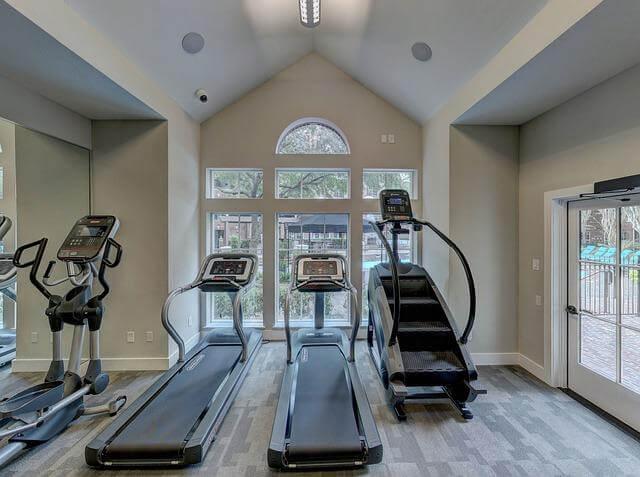
The total cost for this setup runs $300-600 depending on the dumbbell brand. Compare that to the average U.S. gym membership cost of $50-70 per month (IHRSA data), and the home setup pays for itself within a year.
Separating Useful Tech From Expensive Gimmicks
Not everything marketed as “wellness tech” deserves your money or your counter space. After years of smart home products flooding the market, patterns have emerged about what people actually keep using versus what ends up in a drawer.
Worth the investment:
- Smart wearables with open API access (Garmin, Apple Watch, Whoop). These feed data to multiple apps and platforms, so you’re not locked in.
- Air quality monitors. You can’t fix what you can’t measure, and most homes have at least one air quality issue worth addressing.
- Smart lighting with circadian rhythm settings. The research on light exposure and sleep quality is robust. This isn’t a gimmick.
- Connected scales that track trends over time. Single weigh-ins are meaningless. A scale that shows your 30-day rolling average and syncs it to your fitness app gives you real insight.
Overhyped or unnecessary for most people:
- Smart water bottles that remind you to drink. If you need a $40 bottle to tell you you’re thirsty, the problem isn’t technology.
- AI-powered mirrors priced above $1,500. The content is solid, but you can get 90% of the same experience with a tablet mounted next to a regular mirror.
- Recovery boots and percussion guns with app connectivity. The devices themselves can be useful, but the app integration rarely adds meaningful value over manual use.
The test is simple: does this device solve a problem I actually have, or does it solve a problem I’ve been convinced I have? Be honest with yourself. A $30 resistance band set used four times a week beats a $2,000 smart bike collecting dust.
One more thing to watch for: subscription fatigue. Many wellness devices now require monthly fees to access their full feature set. Before buying, calculate the total two-year cost (device price plus 24 months of subscriptions). A $300 smart scale with a $15/month app requirement actually costs $660 over two years. A $60 scale that syncs freely with Apple Health or Google Fit does the same core job for a fraction of the price. Always check whether the hardware works independently of the paid subscription before you buy.
Building a System That Runs Without Motivation
Here’s the uncomfortable truth about home fitness: motivation is seasonal. You’ll have weeks where you’re fired up and weeks where the couch wins. The people who stay consistent aren’t more disciplined. They’ve built systems that reduce friction.
That’s the real value of integrating wellness tech into your home. When your workout space is already the right temperature, your app has today’s session loaded, your playlist is queued, and your wearable is tracking before you consciously decide to exercise, the activation energy drops dramatically.
Research from University College London, published in the European Journal of Social Psychology, found that forming a new habit takes an average of 66 days. Not 21, as the popular myth claims. During those 66 days, every bit of friction you eliminate increases your odds of making it to the other side.
Set up your smart home automations around your fitness routine:
- Morning trigger: Wake-up alarm activates. Lights shift to energizing daylight. Coffee maker starts. Fitness app sends today’s workout to your phone.
- Pre-workout trigger: 15 minutes before your usual workout time, the thermostat drops the gym area to 66°F. A smart speaker announces “workout in 15 minutes” (surprisingly effective as a nudge).
- Post-workout trigger: Workout logged in your app. Lights shift to warm/recovery mode. Smart display shows hydration and protein targets for the next meal.
None of this requires advanced technical skills. Apple Shortcuts, Google Routines, and Amazon Alexa Routines all support these kinds of chains with drag-and-drop setup.
The key is making the healthy choice the default choice. Behavioral scientists call this “choice architecture,” and your smart home is the perfect laboratory for it. When the path to exercise has fewer steps than the path to skipping it, consistency becomes the natural outcome rather than the exception.
Start With One Room and One Problem
The temptation with smart home fitness is to overhaul everything at once. Resist it. Pick the one room where you spend the most active time, and solve the single biggest friction point in that space. Maybe it’s the temperature in your garage gym. Maybe it’s the lack of a structured workout plan on your phone. Maybe it’s the fact that you have no idea how well you’re sleeping.
Fix that one thing. Live with it for a month. Then add the next piece.
The homes that genuinely support health aren’t the ones with the most gadgets. They’re the ones where every piece of technology serves a clear purpose, connects to a larger system, and quietly removes one more barrier between you and the workout you keep telling yourself you’ll do tomorrow.
Tomorrow is a terrible fitness plan. A well-set-up home doesn’t give you that option.