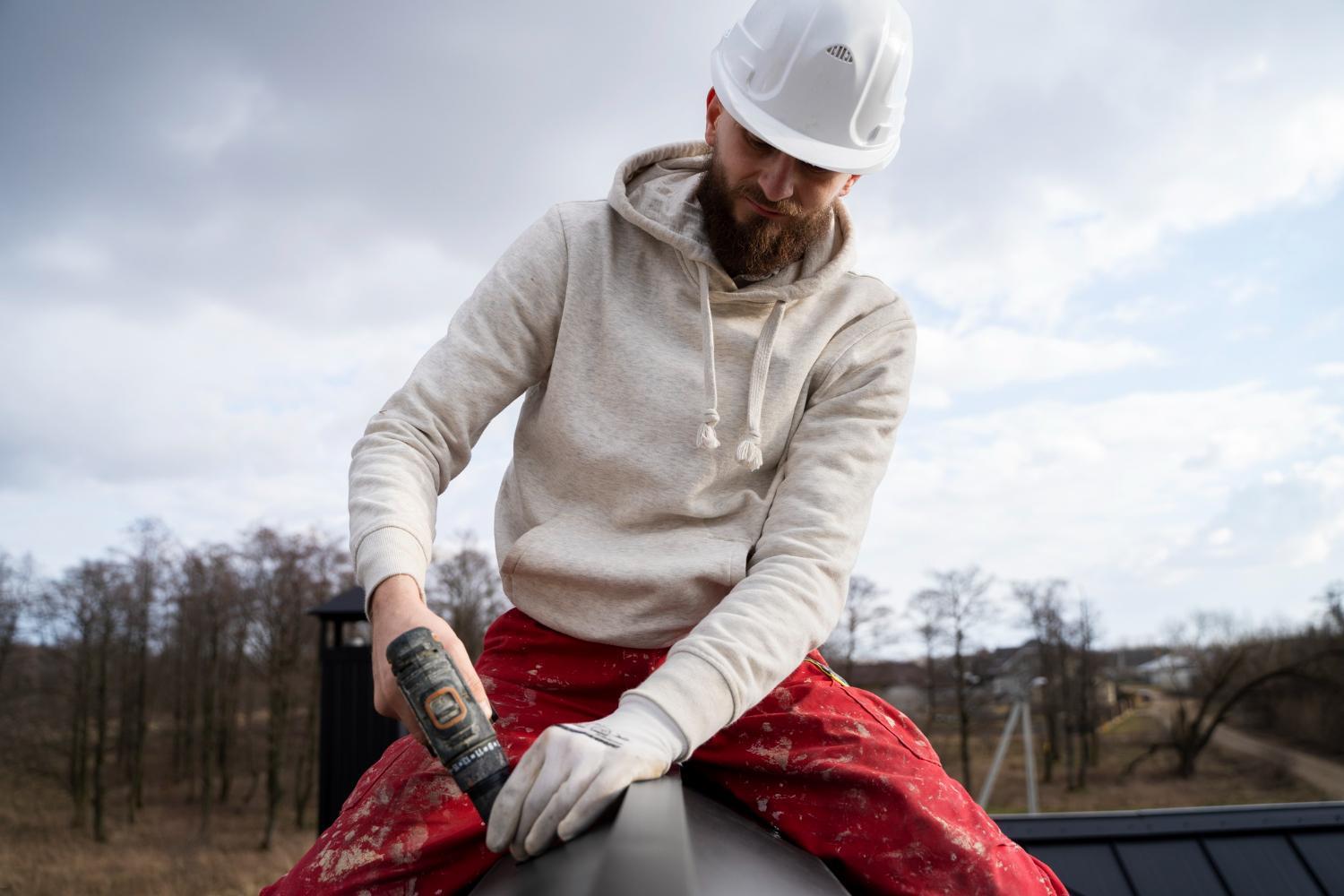
Image by Magnific
There’s a category of home maintenance where the DIY calculus is genuinely close: tiling, deck framing, running a new circuit if you know what you’re doing. You weigh skill against money and pick.
Roofing isn’t in that category, but not for the reason people assume. It isn’t that the work is technically hard. Nailing a shingle correctly takes about ten minutes to learn. It’s that almost every roofing task has a consequence profile completely out of proportion to its difficulty, and the consequence usually isn’t a bad-looking result. It’s water in the wall cavity for two years, or a fall.
The Real Cost Curve
Most DIY decisions have a failure mode you can see and fix. A crooked tile is visible. A wobbly shelf is obvious.
Roof failures are invisible and cumulative. Flashing installed a half-inch short doesn’t leak on day one. It leaks in year three, into a wall, and the first sign is a stain on a ceiling twelve feet from the actual entry point. By then the sheathing is soft and the repair has stopped being about roofing.
That asymmetry is the whole argument, and it’s why the honest split isn’t “easy versus hard.” It’s “reversible versus not.”
Green Light: The Ground-Level Work
Plenty of genuinely useful roof maintenance never requires leaving the ground.
Inspect with binoculars, seriously. From the ground you can spot lifted or missing shingles, granule accumulation in gutter outlets, sagging lines in the roof plane, damaged or rusted flashing at penetrations, and daylight through a ridge vent. A slow walk around the house twice a year catches most problems while they’re still cheap.
Attic inspection is the other half and it’s better than being on the roof. Go up on a bright day with the lights off and look for pinholes of daylight, staining on the underside of the sheathing, damp or compressed insulation, and rusted nail points, which indicate condensation. Then go up again during heavy rain and look for active drips. That single habit finds more problems than any exterior inspection an amateur can perform.
Amber Light: Gutters, and the Job That Hurts People
Gutter cleaning is the task everyone treats as trivially safe, and it is by a wide margin the roofing-adjacent job that sends homeowners to hospital.
It’s also the one where professionals behave most cautiously, which tells you something. Ask anyone at Roofing The Woodlands TX carrying bundles up a two-story pitch in August, and the ladder is the part of the day that gets managed first, before heat, before the roof itself. Crews who are on ladders daily do not freelance with them.
If you do your own gutters, the equipment matters more than the technique: a ladder rated for your weight plus load, a stabilizer bar so the rails sit on the fascia instead of crushing the gutter, and a second person at the base.
Red Light: Anything Involving Water Management
Flashing, valleys, penetrations, chimney counter-flashing, ridge and step flashing. This is where roofs actually leak, and it’s where the details are least forgiving.
The reason isn’t skill, it’s sequencing. Water management on a roof is an overlapping system where every piece has to shed onto the piece below it in the correct order. Get the order wrong and the assembly looks perfect and channels water directly into the structure. There’s no way to test it except waiting for weather.
Red Light: Anything Under Warranty
Worth knowing before you fix a small thing yourself. Manufacturer warranties on roofing materials frequently include conditions about installation and repair, and workmanship warranties from the installing contractor almost always do.
A twenty-dollar tube of sealant applied by the homeowner can, in the wrong circumstances, become the reason a claim gets declined. Read the paperwork before you climb.
The Sealant Trap
Speaking of which: roofing sealant is the single most overused product in home maintenance.
It has legitimate applications, mostly as a supplement to a mechanical detail rather than a substitute for one. What it cannot do is fix a flashing problem, and a bead of black goo around a vent boot is the classic sign that somebody addressed a symptom. It buys a season or two, hides the evidence, and makes the eventual repair more expensive because now there’s cured sealant bonded to everything.
Replace failed boots. Don’t caulk them.
Ladders Are the Actual Hazard
If you take one practical thing from this, take this one, because the data is unambiguous and the fix is free.
Ladder falls are a persistent hazard at home as well as at work, and according to NIOSH’s guidance on ladder safety roughly 40 percent of ladder-related injuries come from the ladder sliding out at the base because it was set at the wrong angle. The correct angle for an extension ladder is about 75 degrees, which you get from the 4-to-1 rule: for every four feet of height you climb, the base moves one foot out from the wall. NIOSH also publishes a free Ladder Safety app with an angle-measuring tool that uses your phone’s sensors, plus tools for selecting the right duty rating and inspecting the ladder before use.
Two more things that are free: extend the ladder at least three feet above the roof edge so you have something to hold at the transition, and tie it off at the top. The transition on and off the roof is where most falls happen.
The Honest Middle Ground
There’s a version of this that isn’t all-or-nothing. Do the inspections yourself, twice a year and after any serious storm, and get genuinely good at reading what you see. Keep the gutters clear, safely. Document everything with photos so you have a baseline.
Then hire out anything involving water management, anything under warranty, and anything requiring you to work on the roof plane rather than at its edge. You’ll spend less overall, because problems get caught early and priced as repairs.
Know Which Job You’re Actually Doing
The mistake isn’t attempting roof work. It’s misclassifying the task.
Before you climb, ask what happens if this is done slightly wrong. If the answer is “it looks bad” or “I do it again,” proceed. If the answer is “I find out in three years” or “I fall,” that’s a different job than the one you thought you were starting. For work involving metal panels, flashing, or more complicated repairs, bringing in an experienced metal roofing contractor may be the safer choice.