Federal Motor Vehicle Safety Administration data shows that big trucks are involved in about 494,000 accidents each year in the U.S. Commercial truck accidents can be a challenging affair to handle in terms of personal injury claims. The difficulty comes from the fact that there are a number of people who could possibly be accountable. You would also have to handle and comprehend the federal regulatory framework that governs the commercial trucking industry.
To address these potential issues, a lawyer can provide guidance and help. According to the law firm website https://www.jgoadlaw.com/, one should get in touch with a legal practitioner when involved in a truck accident. The attorney will research the details of the accident and put together the most efficient strategy to help you recover damages.
When an accident occurs involving a commercial truck, liability may be assigned to various parties. These parties include the driver of the vehicle, the motor company responsible for the truck, the company transporting the cargo, the broker arranging for the transport of the cargo, the packing company, and, at times, even the truck manufacturer.
Let’s discuss the issue of probable liability for truck accidents and how one can seek the recovery of damages sustained.
The Truck Driver: Direct Negligence
In a truck accident case, people often look at the driver’s possible negligence first. A commercial driver is seen as negligent if they disregard the Hours of Service guidelines or operate the truck when they know that they are still too tired to drive. The driver’s disregard of lawful traffic guidelines can constitute a breach of “reasonable care.”
The FMCSA Hours of Service rules say that property-carrying drivers can only drive for 11 hours in a 14-hour window. They then have to take a 10-hour break between jobs. A full Electronic Logging Device (ELD) mandate helps keep track of real driving hours in a way that courts can accept as evidence. If a truck driver breaks these rules and causes an accident, both the driver and the trucking company may be held legally responsible, according to Mississippi truck accident lawyer Rogen K. Chhabra.
Texting, mobile chatting, distracted driving, and speeding are behaviors that constitute negligent driving. Failure to be mindful of blind areas while merging or changing lanes can cause accidents. Tailgating too closely is also a problem, especially since business vehicles need more space to stop than cars. Flatbed trucks not securing cargo and inebriated drivers also contribute to dangerous road incidents.
Commercial drivers can have a BAC of 0.04 percent, which is half of passenger vehicle drivers’ 0.08 percent. Drug and alcohol tests can be used as key evidence if someone dies, is injured, or the vehicle is undriveable.
The Motor Carrier: Vicarious and Independent Liability
The motor carrier, which is the corporation that operates the truck and employs the driver, may face liability under two separate theories. Vicarious responsibility for the driver’s fault precedes direct negligence for the carrier.
When the driver is an employee operating on the job, the doctrine of respondeat superior applies, establishing vicarious liability. A driver can be an independent contractor but a motor carrier will still be held accountable for their actions under USDOT jurisdiction. It has been established by a number of federal trial courts that federal motor carrier law preempts state-created classifications that may serve to protect a carrier from liability. Motor carriers have less protection under the independent contractor classification than other industries.
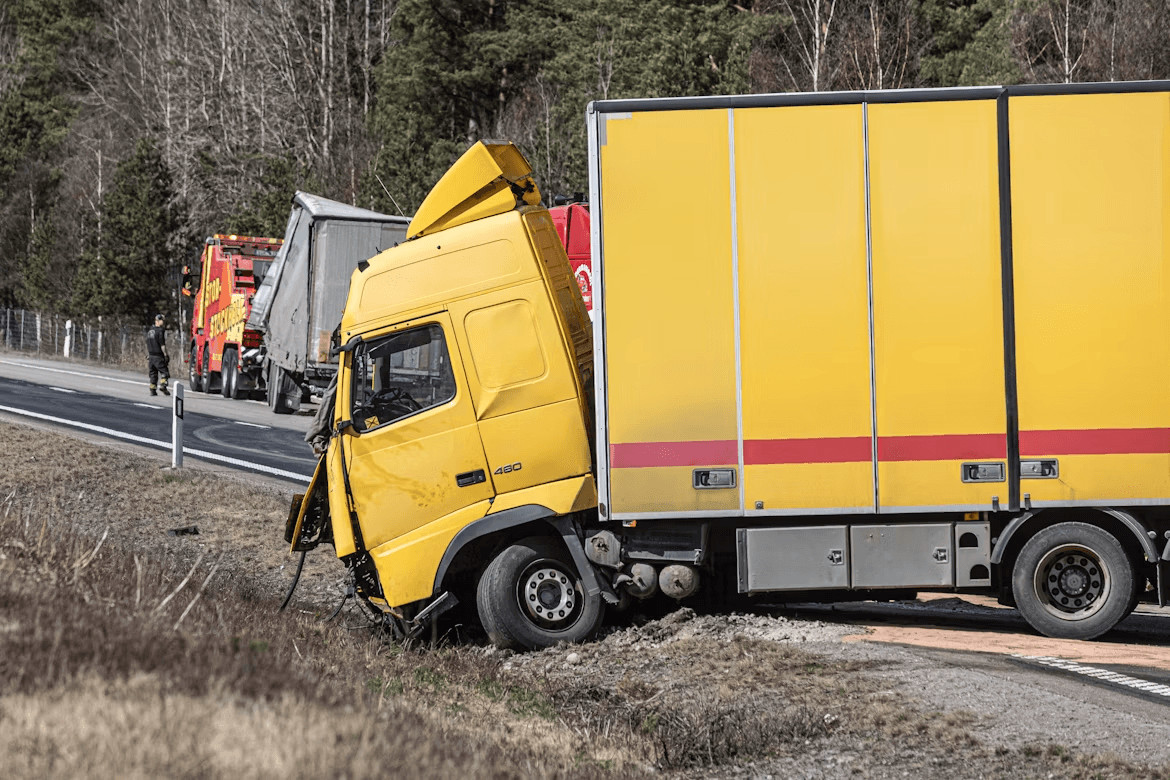
The carrier’s failings cause direct carrier negligence. Carriers must check driver history from every state where the driver had a license in the past three years and use the Pre-Employment Screening Program to check accident and violation history before hiring. These guidelines are outlined under the FMCSA Carrier Safety Fitness Standards. A carrier can be found directly negligent if it hires someone with major infractions or a repeated history of wrecks without investigating. Failing to maintain vehicles can also lead to carrier liability. According to FMCSA regulations, commercial motor carriers are expected to inspect and maintain all commercial vehicles on a periodic basis. Failure to meet these standards may render a carrier legally responsible if they fail to keep the inspection reports and repair the vehicle defects.
The Shipper, Freight Broker, and Cargo Owner
The companies that hire carriers to move their goods are known as shippers. In truck accident situations, shippers can be liable if they improperly secure the cargo. There are federal cargo securement rules, laid out in 49 C.F.R. Part 393, that say how different types of cargo have to be tied down or restrained depending on the travel conditions. If a shipper loads cargo in a way that does not comply with those requirements, and the cargo shifts, slips, or separates during transit, that shipper can be independently liable for negligence based on regulatory violations.
Freight brokers are the intermediaries that arrange shipping without actually taking possession of the cargo. Freight brokers may also be liable if they had prior knowledge of a safety problem but failed to inform the carrier. The FMCSA’s Safety Measurement System, or SMS, tracks how well carriers comply with safety regulations and is available to the public. A freight broker could face negligent selection claims if they still choose to work with truck carriers that have negative SMS numbers and these carriers get involved in an accident.
The Vehicle or Component Manufacturer
When some mechanical failure actually contributes to a crash, then the manufacturer connected to the defective part can face legal action under product liability law. Usually the defect categories seen in truck accident disputes include brake troubles (like hydraulic system failures, brake fade, and air brake defects), tire problems, steering component failures, and malfunctions connected to electronic stability control systems. Product liability for commercial vehicles is handled with the same strict liability rules, along with design defect theories and failure-to-warn concepts, that show up in consumer product matters.
To put together a product defect claim in a truck wreck case, you must keep the evidence from changing or getting lost. The vehicle, or at least the suspected defective component, really should be preserved for expert review before anyone repairs it or sends it to a facility to become scrap. Vehicle event data recorders, which are usually referred to as black boxes, can also generate data on what was taking place in the seconds immediately prior to a crash. These black boxes can show speed and deceleration before the crash. It can also provide the steering angle input and the occupants’ position with respect to the seat belt. These details are huge for accident reconstruction and for sorting out what the driver did versus what the machinery may have done wrong.

In serious truck accident situations, it’s pretty standard to send a spoliation preservation letter to every potentially responsible party fairly quickly after the crash so the evidence doesn’t get destroyed or altered.
Federal Regulations as the Framework for Liability Analysis
The FMCSA’s Federal Motor Carrier Safety Regulations lay out the standards of care that apply to each commercial carrier, driver, and vehicle operating in interstate commerce. When these rules get violated, the violations are admissible as evidence of negligence in civil cases. These regulations are both detailed and specific. They also provide a structured framework for demonstrating a breach. When examining the causes of most automobile accidents, major legal documents that should not be missed are working time charts, personnel due diligence files, substance misuse checkup sheets, and vehicle condition reports. Most truck carriers must keep records of accidents.
There is also the Safety Measurement System developed by the FMCA. This system is accessible on the FMCA website. The system scales lessons through seven Behavior Analysis and Safety Improvement Categories (BASICs): Unsafe Driving, Hours-of-Service Compliance, Driver Fitness, Controlled Substances/Alcohol, Vehicle Maintenance, Hazardous Materials Compliance, and Crash Indicator. If a carrier has higher BASIC percentile scores around the time of the crash, that means there’s already a documented safety performance profile that ties in to direct negligence claims.
The system tends to show the carrier was likely aware of the risk category that helped produce the crash in the first place.