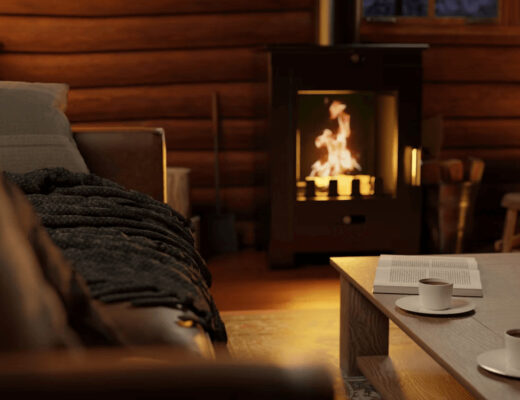
There’s something about wood with a history that new materials can’t replicate. The grain is denser, the color has depth, and the surface tells you it’s been somewhere. Bringing that into a modern home doesn’t mean sacrificing clean lines – it means finding the right balance between the old material and the space around it.
If you’ve been thinking about adding reclaimed shelves to your walls without a major renovation, here are some practical ways to pull it off.
Mix Reclaimed Wood with Metal Hardware
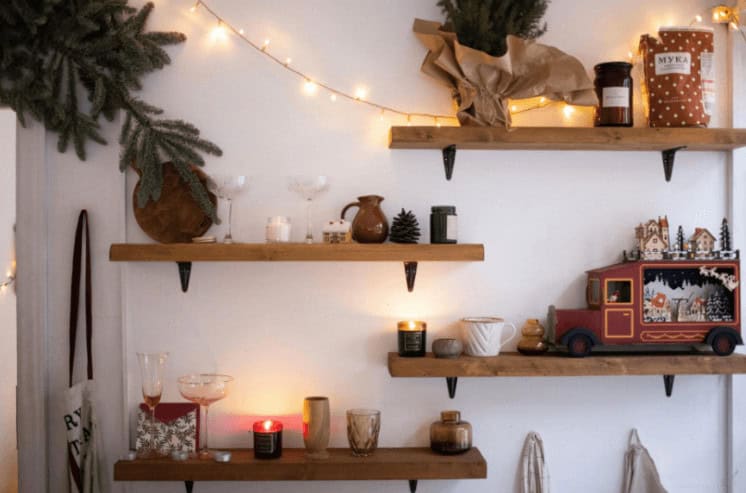
One of the most effective ways to keep reclaimed shelves feeling current rather than rustic is to pair them with industrial-style metal brackets. Black iron or matte steel against weathered wood works in almost any modern interior – it reads as intentional rather than salvaged.
Bracket size matters. Undersize hardware makes the shelf look precarious. Brackets proportional to the shelf depth – or slightly larger – give the installation a more architectural feel, especially when the reclaimed wood is backed or reinforced with sheets of mdf cut to size to ensure consistent thickness and a clean edge.
If mounting into drywall, hit the studs. Heavy reclaimed wood loaded with books isn’t something you want relying on anchors alone.
Use Them as Kitchen Display
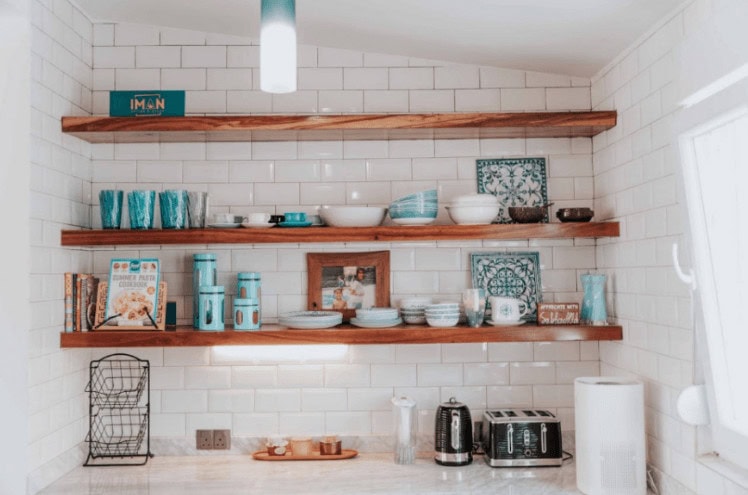
The kitchen is one of the better rooms for reclaimed wood shelving because the warmth of the material offsets harder surfaces – stainless appliances, tile backsplashes, quartz countertops.
Open shelving gets a bad reputation because badly executed versions become dust collectors. Done right, with consistent vessels and only what you actually use, it works.
Keep the display well edited. Matching canisters, a row of cookbooks, and ceramic bowls in two or three tones. The reclaimed wood provides enough visual interest on its own – what’s on it should be restrained.
Float Them at Different Heights
A single shelf at eye level is a missed opportunity. Staggering two or three shelves at varying heights on the same wall creates a more dynamic without adding complexity.
This works particularly well in living rooms and dedicated home offices where you need both display space and functional storage.
Spacing doesn’t need to be uniform. A larger gap between the top two shelves and a tighter one below – or the reverse – tends to look more considered than perfectly even increments.
Anchor a Bathroom with a Single Statement Shelf
Bathrooms are an underused territory for reclaimed shelves. A single wide shelf above the toilet or beside the vanity introduces warmth into a room that typically has none.
Installation is straightforward, and the visual payoff relative to the effort is high.
Seal the wood for bathroom use. Reclaimed wood without a moisture-resistant finish will swell and discolor over time. A few coats of water-resistant finish protect the material without changing its character.
Build a Bedroom Reading Nook
A reclaimed shelf installed at headboard height on either side of the bed – or as a continuous floating ledge – solves the nightstand problem in smaller bedrooms while adding texture to what is often a plain wall.
Keep the surface low enough to reach without sitting up fully and install reading lights underneath if the room needs them.
This works particularly well in rooms with white or light gray walls, where the warm tones of aged wood give the space a focal point it would otherwise lack.
Create a Home Office Accent Wall
A grid of reclaimed shelves on one wall of a home office pulls double duty: storage for books, files, and equipment, and a video call background that doesn’t look like an empty wall.
The texture of reclaimed wood reads well on camera in a way painted walls often don’t.
Keep it practical. If you’re actually working there, the shelves should hold things you reach for regularly. A mix of functional storage and a few well-chosen objects looks better than shelves styled purely for aesthetics.
Style Around a Fireplace
Reclaimed shelves flanking a fireplace are one of the more natural pairings in home design. The material connects to the associations of fire and warmth in a way that painted wood or MDF simply doesn’t.
If the fireplace surround is stone or brick, the reclaimed wood picks up those tones and extends them outward. If it’s painted white, the contrast gives the room definition.
Styling matters as much as the installation here. Odd-numbered groupings of objects, varying heights, and a mix of textures tend to prevent the arrangement from looking flat.
This is also one of the applications where reclaimed wood can do the heaviest lifting in a small space – the fireplace provides a natural anchor, and the shelves extend its presence across the wall without overwhelming it.
To Wrap Up
Reclaimed shelves doesn’t require a farmhouse interior or an industrial loft to work. In the right application, with the right hardware and enough restraint in what you put in it, it fits naturally into modern homes without demanding the rest of the room to change around it.
Start with one wall, get the installation right, and go from there.