
Buying a fence in Southern California isn’t a quick Saturday errand: it’s a long-term investment. In 2025, premium vinyl and clear cedar sit only a few dollars apart, termites hollow dry boards, and Santa Ana winds punish shaky posts. The real decision is long-term cost, not the day-one sticker.
In this guide, we’ll compare 10- and 20-year ownership costs, flag wildfire and pool code changes, and hand you a checklist so you can pick the fence that saves money for as long as you own the home.
The short answer: upfront cost vs. lifetime cost
- Day-one bids: Pine typically runs $10-$25 per linear foot installed and cedar $15-$30, while a vinyl privacy fence runs $15-$40 and redwood $25-$40 (Fixr national averages, 2025).
- DIY path: When you sand and stain every few years yourself, wood can stay the cheaper line on the sheet.
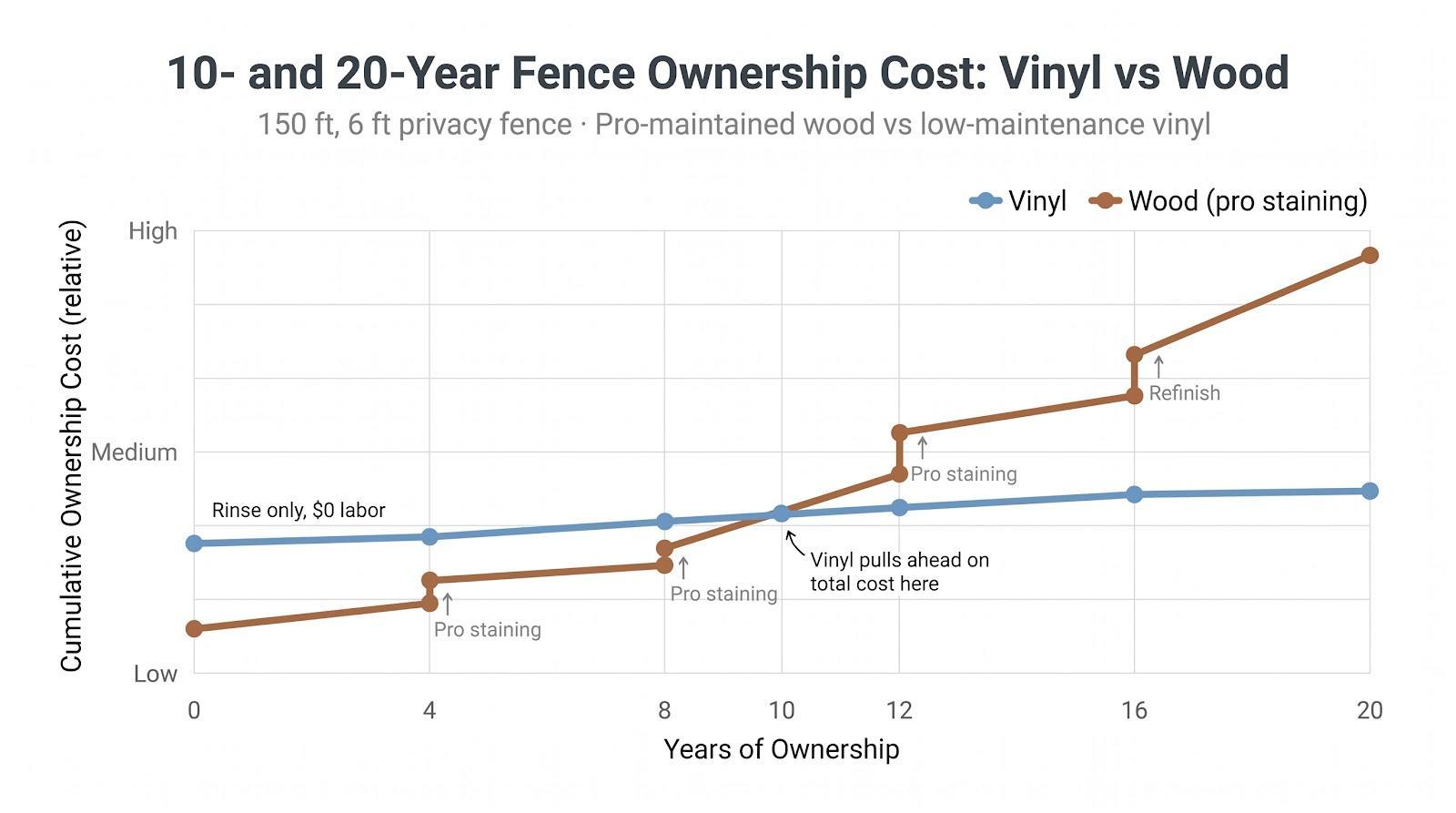
- Pro-maintenance path: Pay a crew to refinish twice in ten years, and the math flips. Those two service calls wipe out wood’s head start, letting vinyl pull ahead.
Bottom line: the winner isn’t the material, it’s the maintenance plan you’ll really follow.
What vinyl and wood cost to install in Southern California
2025 cost benchmarks: your reality check
Fixr’s 2025 cost guides list national average installed costs per linear foot:
| Material | Per-foot range | 150 ft example* | Source |
| Vinyl (privacy) | $15-$40 | $2,250-$6,000 | Fixr vinyl fence cost guide, 2025 |
| Cedar | $15-$30 | $2,250-$4,500 | Fixr wood fence cost guide, 2025 |
| Redwood | $25-$40 | $3,750-$6,000 | Fixr wood fence cost guide, 2025 |
*Totals assume a straight, gate-free, 150-ft run and 2025 dollars.
Key takeaways:
- Vinyl and premium wood sit in the same price neighborhood, not on opposite sides of town.
- Darker or more saturated vinyl colors sit toward the top of that range, and black vinyl runs $55-$65 per foot installed (Fixr).
- Pine starts around $10/ft installed (Fixr), but that bargain carries durability asterisks we will unpack next.
Bottom line: before you factor paint, stain, termites, or Santa Ana winds, vinyl is already trading punches with cedar and redwood in 2025 dollars.
The 10- and 20-year ownership math
Assumptions you can see at a glance
- Footage: 150 linear ft, dead-straight
- Height: 6 ft privacy style
- Gates: 0
- Demolition, permit, survey: not included
- Dollars: frozen in 2025 value (no inflation or financing)
- Wood upkeep: pro staining at year 4 and year 8 (≈ $1,435 each cycle for 150 ft), then again at year 12 and year 16 for the 20-year view
- Vinyl upkeep: garden-hose rinse when dusty, $0 labor
We do not preload wildcards like termite treatment, storm damage, or full tear-out. Those appear later as “what-if” scenarios instead of certainties.
With the ground rules locked, the math can speak for itself.
Why Southern California changes the math
Termites: the quiet carpenters eating into wood ROI
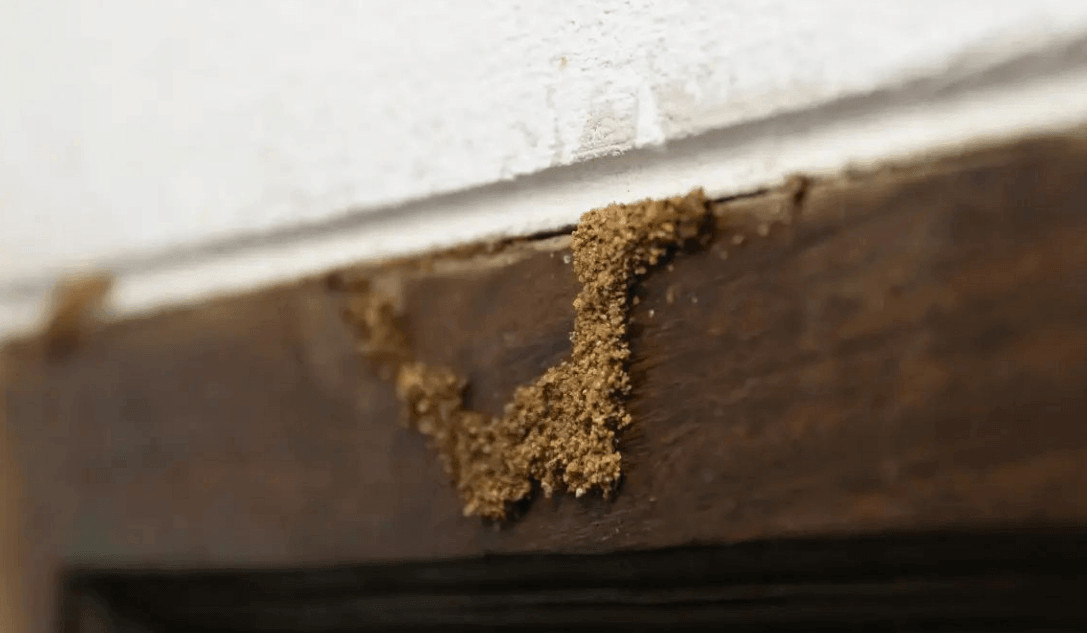
Western dry-wood termites are common from the coast clear into the desert of Southern California, and they do not need damp soil, they burrow straight into above-ground lumber, fence rails included. Vinyl profiles contain 0 % cellulose, so the insects ignore them. That does not make a vinyl fence “termite-proof,” because wood inserts, gate frames, or a nearby pergola still tempt them. Prevention checklist:
- keep sprinklers off post bases
- leave a ½-in soil gap under bottom rails
- seal every cut end on wood parts
If you choose wood, species and treatment matter. Heartwood cedar or redwood resists attack better than sapwood pine, but posts that sit in soil still need preservative rated UC4A (ground contact) under AWPA Standard U1. Skimp here and a bargain post can crumble long before your year-10 refinish bill.
Bottom line: know which critter lives in your ZIP code. Western dry-wood is widespread, while Formosan subterranean termites remain rare and localized in Southern California. Either way, durability depends on the lumber spec you write into the contract, not just the material label.
Santa Ana winds: pressure comes from design, not just material
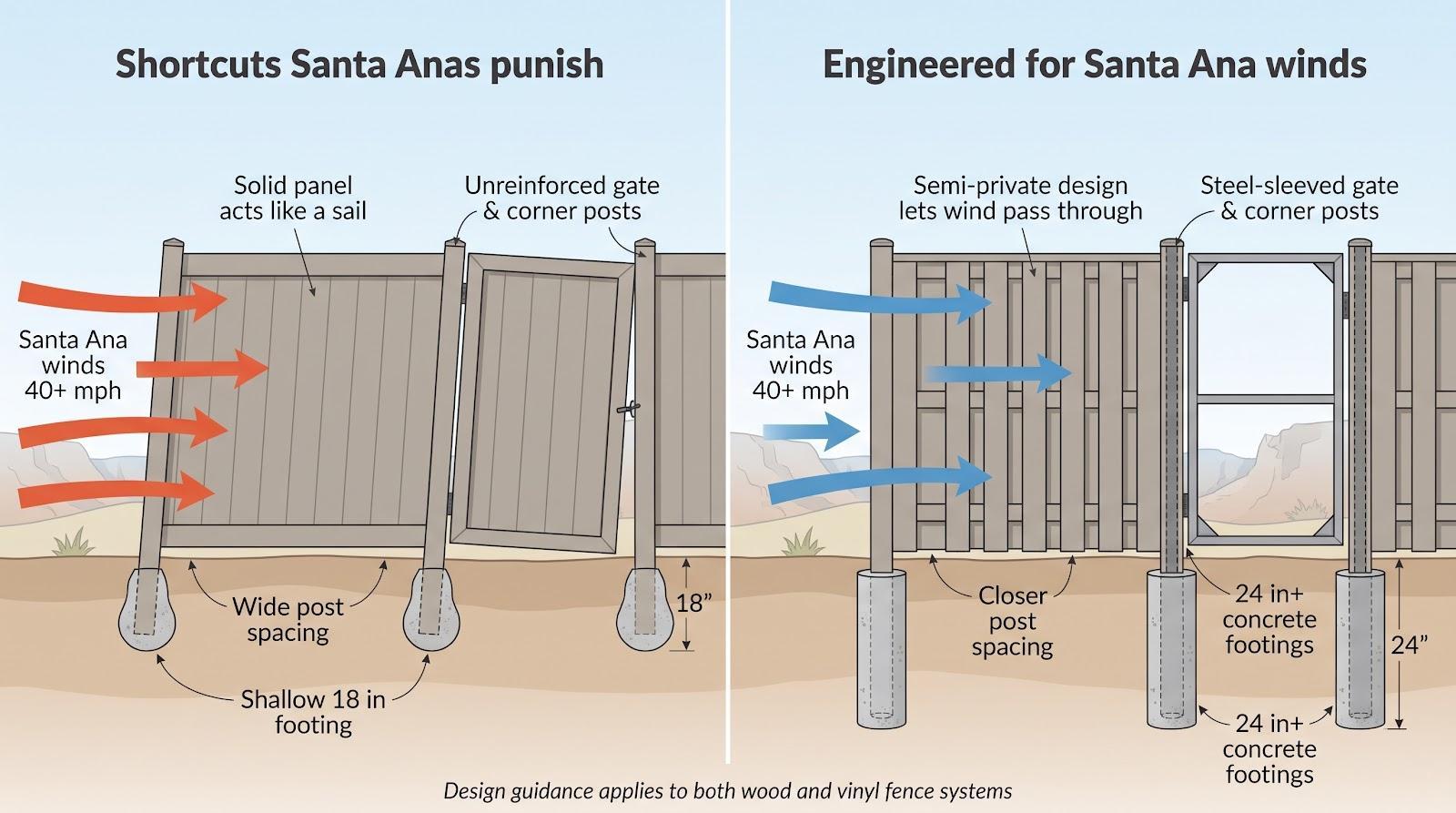
Santa Ana season runs roughly from October through April. A solid 6-ft privacy panel acts like a sail, so an open-board picket often survives gusts that snap a solid wall, no matter if it is wood or vinyl.
What really decides the outcome sits below grade:
- Wide post spacing or shallow footings invite wobble
- Steel-framed gates and tighter post centers at corners stiffen the run
- Posts buried 24 in+ into concrete, rather than the 18 in many bids quote, handle gust loads far better
Some manufacturers publish those wind numbers up front.
Vinyl Fence Depot’s FAQ says its products are designed to withstand normal wind load, with engineered wind load tests to 110 mph without any internal post support, and that internal supports add further wind resistance.
Ask every bidder for a drawing that lists post spacing, footing diameter and depth, and any corner or gate reinforcement. If a bidder quotes a wind rating, ask which fence assembly was tested.
Bottom line: Santa Ana season punishes shortcuts, not specific fence materials. Strength comes from the system you buy, not the plastic or lumber you can touch.
Sun, heat, and drought are not the same thing
Southern California’s inland valleys routinely push 100-105 °F (38-41 °C) during summer heat advisories. That UV and heat combo bakes fences every day.
Vinyl: Survival hinges on formulation. Profiles need titanium-dioxide UV blockers and heat stabilizers; lighter colors run cooler. Skip those ingredients and you will see chalking, fading, and brittle rails no warranty will repaint.
Wood: Pigmented stain or paint is its sunscreen. Leave boards bare and they gray, check, and slough surface fibers. Weathering starts cosmetic but opens cracks where water seeps once the rains return.
Drought ≠ rot. Fungus still needs moisture. The real risk is owners skipping a re-stain while sprinkler overspray keeps post bases wet, the top rail looks sun-bleached, the bottom rail quietly rots.
Upkeep cheat sheet:
- Rinse vinyl before dust bakes on
- Restain wood when the first thin spots appear, do not wait for splits
The calendar does not care whether the fence is plastic or plank, solar load runs the schedule.
Wildfire: the last 5 ft to the house
Neither vinyl or wood fence wins a fire fight. Embers melt vinyl and ignite dry boards alike. California’s proposed Zone 0 rule, approved by the Board of Forestry on Aug 19 2026 then withdrawn from Office of Administrative Law review in September 2026 and placed back on the Board’s November 2026 agenda (not yet in force), calls for a non-combustible break where fencing meets a structure. The safest play is a short metal section or gate in that final 5 ft (CAL FIRE Home Hardening: Fences).
Ask bidders to spell out that transition, include material, hardware, and code reference, and confirm it matches the 2025 code cycle now in force. Insurers often look for the same detail under the Safer from Wildfires framework, so a slim section of steel can protect both your siding and your premium.
Codes, permits, pools, and neighbor costs
Building-permit exempt? Only on paper
California’s Residential Code skips a building permit for fences ≤ 7 ft high, but that waiver is only the front gate. Zoning caps, corner sight-lines, wildfire buffers, and HOA design rules still apply. A 6 ft privacy run that clears the permit desk can still trigger Planning review if it flanks a street or climbs a hillside.
Add one more filter: who is allowed to build it. Any paid fence job ≥ USD 1,000 or any project that needs a permit requires a CSLB-licensed contractor, bonded and insured, with a name you can verify online. Hire an unlicensed crew and you accept their liability along with that tempting low bid.
Translation: “permit-free” does not mean “code-proof,” and the cheapest quote can turn costly once enforcement steps in.
Local height limits: six-jurisdiction snapshot
| Jurisdiction | Front yard | Side / rear | Notes |
| Los Angeles City | 3.5 ft solid | 6-8 ft (hillside dependent) | Masonry needs a permit > 3.5 ft |
| Uninc. L.A. County | 42 in front | 6 ft side | Overlay districts add view and wildfire buffers |
| Orange County | 3.5 ft solid; 5 ft open | 6 ft | Community plans may vary |
| Anaheim | Up to 7 ft needs Planning OK | Not listed | Permit-exempt still reviewed |
| Ventura County | 3 ft solid; 5 ft open | 7 ft rear | Taller needs zoning clearance |
| Riverside City | 4 ft front (openwork above 3 ft) | 7 ft rear | Variance for > 7 ft near ROW |
Always pull the parcel’s zoning sheet before pricing a single post hole.
Pool barriers: more than just a tall fence
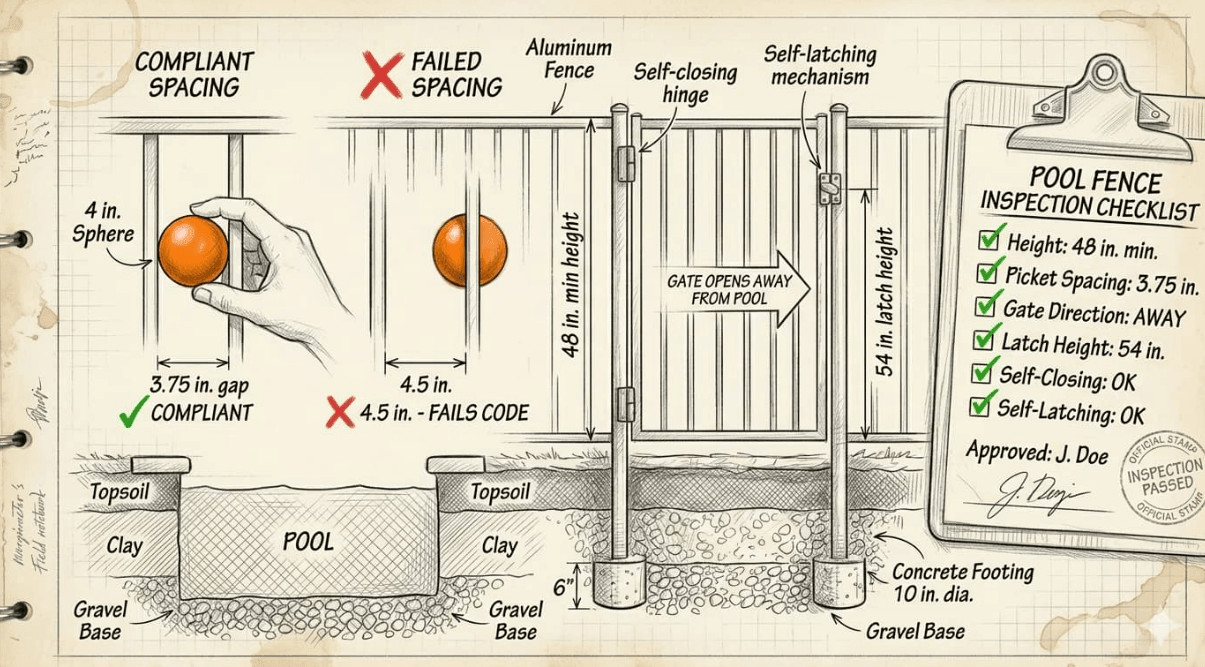
That 6 ft privacy wall feels secure, but California pool law adds details style alone cannot cover. For any new or remodeled single-family pool, the enclosure must:
- Stand ≥ 60 in high.
- Swing its gate outward from the water.
- Self-close and self-latch every time, with the latch ≥ 60 in above grade.
- Block a 4 in sphere anywhere below the top rail.
- Keep the bottom gap ≤ 2 in from the ground.
Miss one rule and the fence stops counting as a safety feature, meaning you will need a second approved layer (alarm, safety cover, or compliant door) to meet the state’s two-feature requirement. Skip both and the inspector will not sign off, no matter how perfect that tile line looks.
Plan ahead: tell each bidder if a pool exists or is on the way, and have them list hardware specs, latch height, and gate swing in writing. It is cheaper to pour the right footing once than dig it out after a red tag.
Neighbor law: sharing cost without sharing drama
California’s Good Neighbor Fence Act (Cal. Civ. Code § 841) treats a boundary fence as a mutual benefit, so each owner is presumed to pay 50 % of reasonable construction or repair costs, unless one side can prove the work serves only the other.
- Notice first: Deliver a written letter ≥ 30 days before work starts describing the problem, proposed fix, and cost estimate. Skip the letter and you lose leverage if the dispute reaches small-claims court.
- Reasonable ≠ deluxe: Decorative caps, premium stain, or extra height sit outside what a neighbor must pay. A common compromise is that the upgrader covers the premium while both split the base price.
- Talk, then build: A five-minute chat now beats a fence-line stare-down later.
This is planning guidance, not legal advice. When in doubt, talk with the neighbor first, then a qualified attorney.
Durability, repairs, appearance, and the environment
Repairability and parts continuity
Life happens: a dog slams the bottom rail, a delivery truck kisses a gate post, or a sprinkler floods one footing. How fast you bounce back depends on the material you chose.
Wood: Pop out a damaged board and slip in a match from the lumber yard. Typical pro repair: USD 400-600 (Fixr 2025). Posts and gates can be nursed along the same way, piece by piece, with hardware you can grab on a Saturday.
Vinyl: Profiles lock together, so one cracked plank may mean swapping a whole panel; typical vinyl repairs run USD 200-700 on average (Fixr 2025). That fix is painless if the installer still stocks your style and color. If the line is discontinued, you might hunt online auctions for a close cousin that never quite matches.
Pro tip: ask every bidder:
- How long will you stock spare profiles?
- Can the fabricator run small batches years later?
- What does the “lifetime” warranty exclude?
Either way, set aside a small repair fund. Minor fixes start near the numbers above, while storm damage can climb toward USD 2,500 (Fixr 2025). Knowing the range now spares you sticker shock later.
Aesthetics and HOA fit
Looks still seal the deal. Wood brings natural grain that warms a Craftsman porch or frames a cottage garden with that “been-here-forever” vibe. Clear cedar can wear sheer oil, deep espresso stain, or crisp white paint, changing personality whenever a new color trend hits.
Vinyl swings the other way: factory color, factory sheen, factory texture. What you pick on install day is what you will see at every sunrise after. HOAs like that predictability because uniform color keeps streetscapes consistent. Expect a premium and extra heat load for darker or embossed wood-grain vinyl. Dark PVC profiles can run noticeably hotter than white ones in the same sun.
Before you fall for a sample chip, set a full panel outside. Light shifts: a satin-finish white picket can glare bright at noon and glow soft at dusk. Snap photos, compare at 7 a.m. and 5 p.m., and see whether the tone matches your stucco, roof tile, and trim.
If an HOA enters the chat, grab the design rules first. Some boards ban bright whites, others forbid unfinished lumber, and many demand pre-approval for height, lattice, or post caps. Bringing the spec sheet to the first review meeting saves redraws, rejections, and rush fees later.
Resale value: no magic percentage, just curb appeal and compliance
Real-estate agents walk buyers along the fence line for one reason: condition sells privacy. A straight, code-legal barrier whispers “well kept,” no matter the material. A leaning panel, flaking paint, or mismatched patch screams deferred maintenance and invites low offers.
Appraisers back that up: the Appraisal Institute says contributory value flexes with neighborhood norms, buyer profile, and how nearby comps look, and there is no universal ROI percentage. In a tract full of vinyl, a glossy white run blends in and protects price; on a historic street of cedar pickets, a plastic wall can ding curb appeal.
Focus on what buyers notice first:
- posts that stand plumb
- gates that latch with one hand
- a finish that looks intentional, not overdue
Nail those basics and the fence adds quiet confidence to your listing instead of dragging it down.
Environmental and disposal nuance
Wood: Renewable and stores carbon while the tree grows. A broken cedar board can become mulch, unless it is pressure-treated. In California, treated-wood waste is classified as hazardous and must go to an authorized facility, not the weekend burn pile (DTSC TWW rules). Plan for disposal fees and a drive to the correct site when the fence finally comes down.
Vinyl (PVC): Skips solvent-based stains and paint for life. Production relies on fossil feedstocks and chlorine chemistry, and local end-of-life recycling is still scarce; most panels end up in landfill (EPA C&D pathways report).
Sustainability boils down to three levers you control:
- Source smart: certified lumber or a vinyl brand with an Environmental Product Declaration.
- Make it last: correct install plus timely upkeep keep any fence out of the waste stream longer.
- Exit plan: locate a treated-wood drop-off or a recycler that grinds clean PVC into new profiles before demolition day.
Material labels matter less than the stewardship choices you make across the fence’s whole lifespan.
Which fence is the better buy for your property?
You have seen the 2025 price bands, watched Santa Ana winds bully sloppy installs, and met the termites that hollow dry boards. Now let us turn that insight into a clear vinyl-or-wood call.
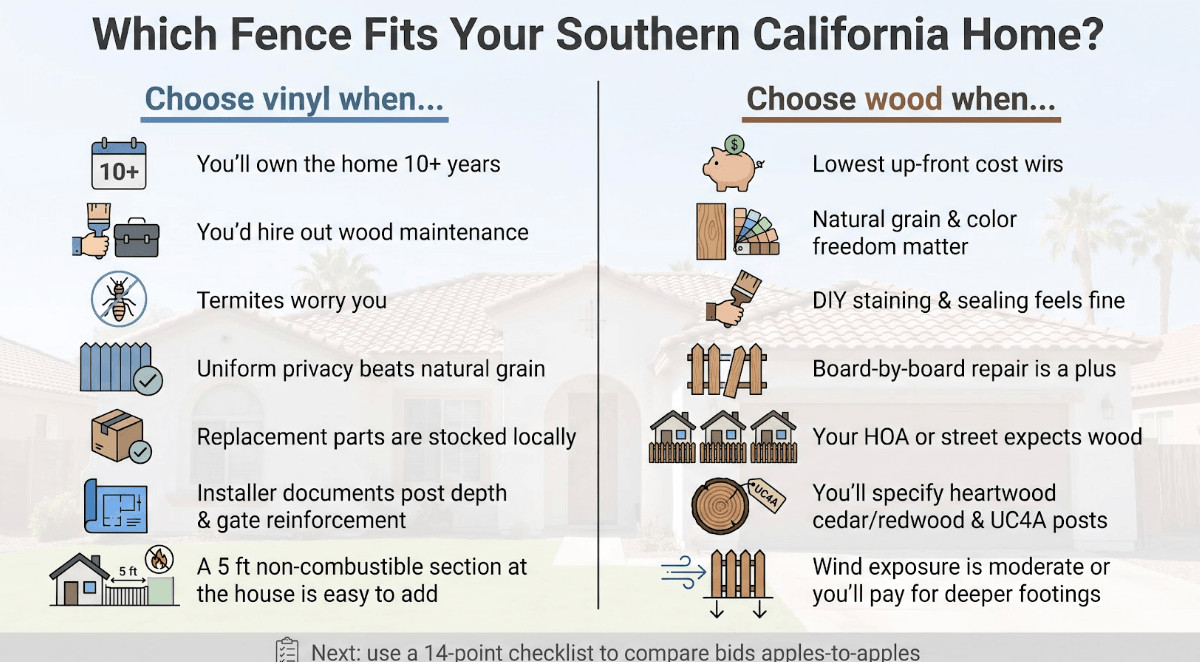
Choose vinyl when
- You will own the home at least 10 years and prefer to skip paid refinishing cycles.
- You would hire out wood maintenance, so labor costs would erase wood’s up-front savings.
- Termites worry you, and a non-cellulosic profile brings peace of mind.
- Uniform privacy and color beat natural grain for your curb-appeal goals (and often please HOAs).
- Replacement parts are stocked locally and the product warranty transfers to the next owner.
- Your installer can document post depth and gate reinforcement that matches local Santa Ana wind exposure.
- A non-combustible 5 ft transition to the house is easy to add for wildfire compliance.
Choose wood when
- Lowest up-front cost wins, and you are willing to trade future sweat equity for today’s savings.
- Natural grain and color freedom matter; you want to stain espresso this year and paint white next.
- DIY maintenance feels fine: sanding and sealing on a Saturday does not scare you.
- Board-by-board repair is a plus because kids, pets, or backyard sports will hit the fence.
- Your HOA or street sets a wood precedent, and you would rather match than fight design review.
- You are ready to specify heartwood cedar or redwood and UC4A posts to keep termites at bay and posts solid in SoCal soil.
- Wind exposure is moderate, or you will budget for closer post spacing and deeper footings.
Your apples-to-apples quote checklist
- Exact footage & finished height
- Style & opacity (privacy, semi-private, picket)
- Board/rail/post specs: species or PVC profile series
- Post spacing + footing size (diameter & depth)
- Gate count, frame material, hardware grade
- Corner & gate reinforcement details
- Demo & disposal plan for the old fence
- Permit / planning responsibilities (who pulls, who pays)
- Pool or wildfire compliance features
- Warranty terms: product vs. labor
- Replacement-parts availability (years stocked)
- Wood finish schedule: stain type, coats, color match
- Wind-rating evidence (test or engineer letter)
- Payment schedule that follows California deposit rules
Set the bids side by side, trace each line above, and the clear winner often appears before you even total the columns.
Frequently asked questions & closing thoughts
Is vinyl termite-proof?
PVC contains 0 % cellulose, so profiles stay safe, but wood gate frames or a nearby pergola can still invite an infestation. Regular inspections and smart lumber specs remain step one.
Does vinyl always outlast wood in Santa Ana winds?
No. Post spacing, footing depth, and gate reinforcement, not the base material, decide who survives a strong Santa Ana gust. A well-engineered wood fence can beat a flimsy vinyl wall.
Which costs less over 20 years?
If you will pay a pro to stain wood on schedule, vinyl tends to win by the second refinish. Handle the brush work yourself and premium wood can stay cheaper until at least year 15.
Will a new fence raise my insurance or property value?
Insurers focus on wildfire and pool safety features, not the brand of fence. Appraisers care about straight lines, code compliance, and neighborhood fit, and there is no universal ROI percentage. A tidy, legal fence removes buyer objections, while a leaning eyesore invites low offers.
―――――――――――――――――――――――
A fence is a promise to future you: fewer chores, lower bills, and better mornings with coffee in hand. Pin down the maintenance you will realistically do, match the material to Southern California quirks, and make sure every bidder answers the 14-point checklist. Follow the facts, not the sales pitch, and the right fence will choose itself.
