Hiring a commercial general contractor in Manhattan is rarely as simple as comparing three quotes and choosing the lowest. A contractor might have an impressive portfolio, but can they coordinate deliveries to a Midtown office tower with limited freight elevator access?
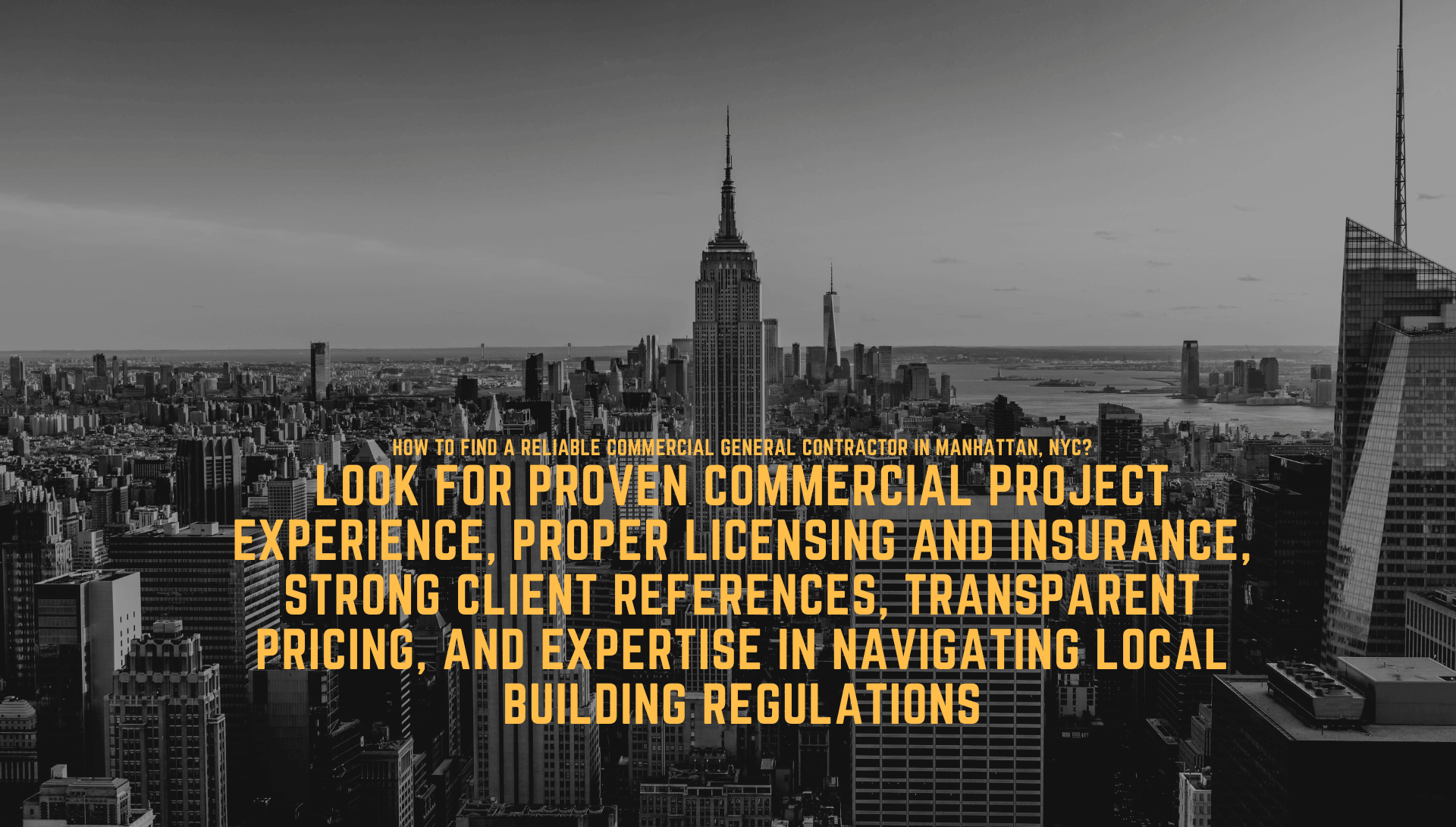
Do they understand the approval process for renovating an occupied commercial building?
And who takes responsibility when a project encounters unexpected conditions behind the walls?
These are the questions worth asking before signing a construction contract.
Whether you’re preparing a new office in the Financial District, renovating a workspace in Chelsea, or planning a commercial build-out near Columbus Circle, finding the right contractor begins with understanding what the job demands.
Here are seven ways to narrow your search and choose a commercial construction partner with confidence.
1. Start with contractors who specialize in commercial interiors
A beautiful residential renovation doesn’t necessarily demonstrate the experience required to complete a commercial office build-out.
Commercial construction involves coordinating multiple trades, working around building operations, meeting accessibility and fire safety requirements, and delivering spaces that must function for employees, customers, or tenants.
Begin by searching for contractors whose portfolios include projects similar to yours. Useful searches include:
- Commercial general contractors in Manhattan
- NYC office renovation contractors
- Office fit-out contractors in New York City
- Commercial interior construction companies in Midtown Manhattan
Pay attention to the distinction between a company that occasionally undertakes commercial projects and one that regularly works in offices, retail spaces, restaurants, and other business environments.
A contractor familiar with Manhattan commercial interiors is more likely to anticipate the practical complications of working in high-rise buildings, older properties, and busy commercial districts.
2. Look beyond the portfolio photographs
Finished interiors tell you what a project looked like. They reveal much less about how the construction was managed.
When reviewing a contractor’s work, look for information about the project’s location, square footage, scope, and construction schedule. A detailed case study is more useful than a gallery of attractive photographs.
For instance, Blueberry Builders, an NYC based general commercial contractor specializing in high-end commercial interiors, has documented office construction projects across Manhattan. Their portfolio includes an 18,000-square-foot Versace flagship office and showroom near Columbus Circle, completed on a 12-week construction schedule, and a 30,000-square-foot headquarters for Zeta Global in Midtown.
These examples give prospective clients something concrete to examine: the scale of the work, the types of commercial environments involved, and the contractor’s experience coordinating substantial interior build-outs.
When speaking with any prospective contractor, ask which completed project most closely resembles yours and what challenges the team encountered along the way.
3. Verify credentials and insurance before discussing the contract
A polished website and strong recommendations are encouraging, but they aren’t substitutes for checking a contractor’s credentials.
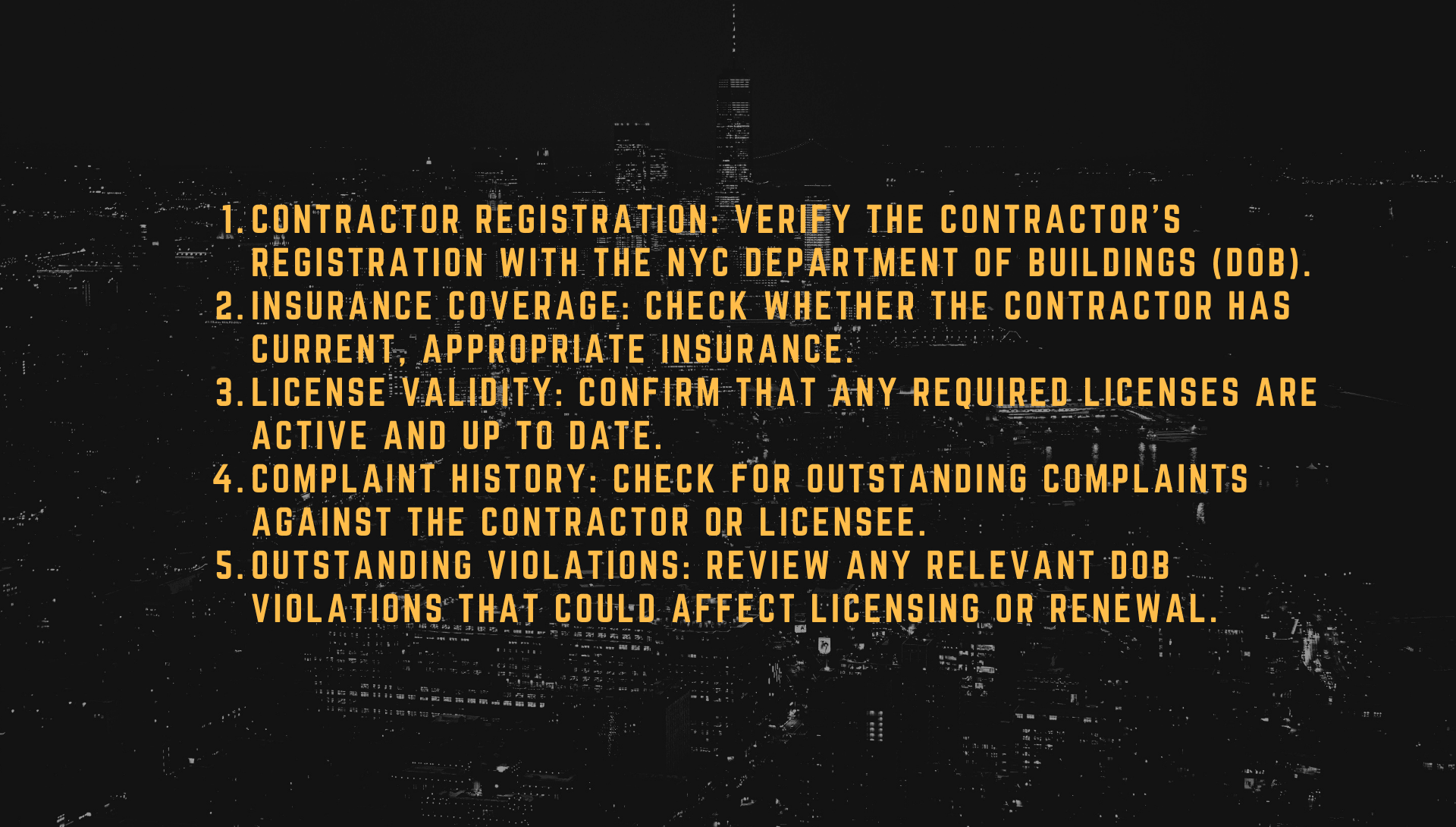
New York City’s Department of Buildings maintains public information about contractor registrations, licenses, and insurance. Requirements vary according to the construction activity and the permits involved.
Before proceeding, confirm:
- The contractor holds the appropriate NYC registration, license, or authorization for the proposed work.
- Required general liability, workers’ compensation, and disability insurance is current.
- The contractor can satisfy any additional insurance requirements imposed by your building.
- The team understands which permits, inspections, and approvals the project requires.
The NYC Department of Buildings provides guidance on checking license and insurance information through its public systems.
Manhattan commercial landlords may also impose their own contractor requirements. Ask the building’s management team for its alteration agreement and insurance specifications before finalizing your shortlist.
4. Ask how they handle Manhattan’s building restrictions
Two offices with identical floor plans can present very different construction challenges.
One building may permit noisy work during normal business hours. Another may require demolition, material deliveries, or certain installations to happen overnight or on weekends.
Freight elevator reservations, loading dock access, protection of common areas, and restrictions on storing materials can all influence the construction schedule.
Ask prospective contractors how they would manage these conditions.
A knowledgeable contractor should be able to explain how building rules affect sequencing, labor scheduling, deliveries, and costs. They should also identify which approvals need to be secured before construction begins.
For an occupied office, discuss how the contractor plans to separate construction activities from employees and visitors.
A proposal that accounts for these realities is generally more useful than one built around an ideal schedule that assumes unrestricted access.
5. Compare what each construction quote actually includes
Suppose three contractors submit proposals for the same Manhattan office renovation.
One comes in substantially below the others. That could indicate an efficient approach, but it could also mean certain work has been excluded, materials have been priced differently, or the contractor has made assumptions that haven’t been explained.
Rather than comparing only the final numbers, examine the scope behind them.
Look for clear information about demolition, carpentry, finishes, mechanical and electrical work, plumbing, site supervision, waste removal, and project management.
Ask which items are allowances, which are fixed, and which remain subject to further investigation.
Also establish how changes will be priced and approved. In older Manhattan buildings, unforeseen site conditions can require adjustments after work begins.
A reliable commercial general contractor should be willing to walk through the proposal and explain its exclusions without leaving you to interpret vague line items.
6. Find out who will actually manage the construction
The person presenting the proposal may not be the person managing your project once construction starts.
Before hiring, ask to meet the project manager or superintendent who will oversee the work.
Find out how often they’ll be on-site, how subcontractors are coordinated, and how progress will be reported.
It’s also worth asking how the contractor handles delays, design revisions, and disagreements between trades.
For office renovations, coordination becomes particularly important when electrical systems, HVAC equipment, lighting, partitions, and custom millwork must be installed in a specific sequence.
A contractor who can describe that sequence clearly is giving you a better indication of their working methods than one who simply promises to finish on time.
Request references from clients whose projects were completed recently and were similar in scope. Ask those clients whether communication remained consistent after the contract was signed and how unexpected problems were resolved.
7. Discuss the schedule before committing to a start date
Commercial tenants often work toward a fixed opening or occupancy date. That makes construction scheduling one of the most important parts of the contractor-selection process.
An office fit-out involves more than the days spent physically constructing the space.
Design coordination, approvals, procurement, building access arrangements, inspections, and final corrections can all affect when the office is ready for use.
Ask contractors to prepare a preliminary schedule identifying major construction phases and activities that could delay completion.
Pay particular attention to long-lead materials, custom fabrication, and building-specific approvals.
If your lease commencement date is approaching, involve the contractor early enough to assess whether the proposed design and timeline are realistic.
A credible schedule should acknowledge dependencies and constraints rather than promise an unusually fast completion without explaining how it will be achieved.
Questions to ask a Manhattan commercial contractor before hiring
Once you’ve narrowed the field to two or three companies, use the same questions in every interview:
- Have you completed office or commercial interior projects of similar size in Manhattan?
- Can you share relevant project examples and recent client references?
- Who will manage the site and coordinate subcontractors?
- What permits, building approvals, and insurance documents will be required?
- Which costs are excluded from your proposal?
- How will you handle changes, unforeseen conditions, and schedule delays?
- What could realistically prevent this project from being completed on time?
The final question is especially revealing. An experienced contractor should be able to discuss potential obstacles without treating every concern as a sales objection.
Where should you begin your search?
Start with recommendations from commercial architects, workplace designers, property managers, and business owners who have recently completed projects in Manhattan. These professionals often have firsthand experience working with contractors through an entire construction process.
Use those recommendations to build a shortlist, then review each company’s commercial portfolio, verify its credentials, and request comparable proposals.
For office construction specifically, prioritize contractors with documented experience in Manhattan workplaces rather than relying solely on broad claims about general construction expertise.
The goal isn’t simply to find someone who can build the space shown on your architectural drawings.
It’s to find a team that understands the building, the approvals, the construction sequence, and the practical demands of getting a New York City business ready to open its doors.