Turning a basic backyard into a space where kids actually want to spend time doesn’t require a complete overhaul or a massive budget. It does require a bit of thought about how the space is laid out, what goes into it, and how to make it work safely for people of different ages and activity types. Get the foundations right, and the rest tends to fall into place naturally.
Start with the layout before anything else
Before buying a single piece of equipment, it’s worth spending some time thinking about how the yard is currently set up and where things could go. The most functional backyards tend to have defined zones rather than one undifferentiated space trying to do everything at once.
An area for active play, a softer zone for younger kids, and a place for adults to sit and supervise without hovering all benefit from being thought about upfront rather than retrofitted later. Good visibility from the house is also worth prioritizing early. Being able to see the play area from the kitchen window or back door makes a real difference to how relaxed parents feel when kids are outside independently.
Get the surface right before installing anything
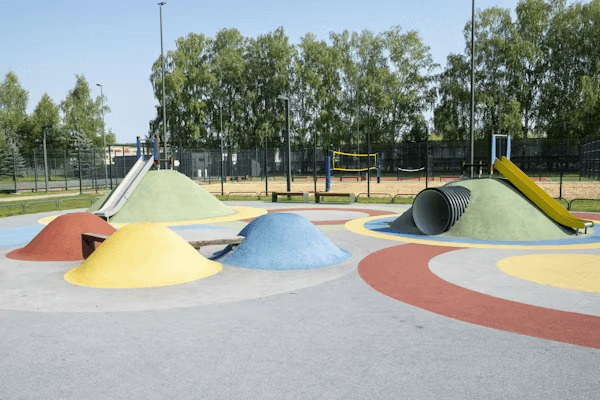
Surface is one of the most important and most overlooked aspects of a safe outdoor play space. Grass is a reasonable starting point for low-level activity, but it wears away quickly under play equipment, becomes slippery when wet, and doesn’t provide adequate impact absorption under anything with significant height.
Rubber tiles or wet-pour rubber surfacing is the better option for areas under swings, climbing frames, and monkey bars because they cushion falls in a way that bare ground or compacted grass simply can’t. The right surface should always be matched to the critical fall height of whatever equipment sits above it, so it pays to sort this out before installation rather than trying to address it afterwards.
A flat section of hard surface, whether pavers, concrete, or compacted gravel, is also worth including somewhere in the yard. Kids on bikes, scooters, and skates need a smooth surface to really enjoy themselves, and having a dedicated circuit or flat area helps keep faster-moving activities away from softer play zones where younger children might be.
Hard-surface areas can also work well for games such as hopscotch, basketball, or simple ball drills. A portable hoop and a QBounce silent basketball, for example, can give kids another way to practice their skills, particularly when play sometimes moves between outdoor and indoor spaces.
Fencing and boundaries matter more than you realize
A properly secured yard is the foundation of independent outdoor play. Kids can’t be left to play freely outside if there’s any doubt about whether the space is contained. Fencing should be checked for gaps, loose sections, and gates that latch securely and are easy for adults to operate.
If there’s a pool or water feature anywhere on the property, the fencing requirements become non-negotiable, and in most parts of the US, they’re also a legal obligation. Even without a pool, knowing the yard is properly enclosed means parents can step back and let kids play without constant supervision, which is exactly the dynamic that makes outdoor time sustainable day to day.
Choosing equipment that’s genuinely safe and worth having
Once the space is sorted, the equipment choices become much more straightforward. The most important thing is buying gear that’s built to last and meets US safety standards, rather than opting for cheaper options that degrade quickly or aren’t engineered for the forces kids actually put through them.
Powder-coated steel and treated timber are the materials worth looking for. UV-resistant plastics hold up far better in US conditions than standard plastics, which crack and fade within a season or two.
For families looking for something that covers multiple developmental bases at once, a backyard trampoline is one of the most consistently high-use additions available. Vuly Play’s range is worth looking at for families who want safety engineering and durability built in from the ground up, with options that suit different yard sizes. The jumping motion builds balance, coordination, and core strength while also providing sensory regulation benefits that make a real difference to kids’ mood and focus after school.
Swing sets, climbing frames, and monkey bars round out a well-equipped yard nicely. Large inflatables for home use, such as bounce houses, inflatable obstacle courses, and water slides, can also provide hours of active entertainment while creating a fun focal point for family gatherings and special occasions.
The key is choosing modular systems and quality products that can be adapted as children grow, rather than fixed structures that become redundant within a few years. Starting with a solid base and adding new features over time is a smarter approach than trying to do everything at once.
Where to get your hands on a trampoline
Trampolines are easy to get your hands on, but not all are equal in quality. Buying a trampoline for your backyard is an investment that needs some forethought. Vuly Play offers a wide range of high-quality trampolines designed to keep your child well into their teen years. All you need to do is choose the right size, and you’re all set.
Final thoughts
Preparing a yard for safe outdoor play is mostly about getting the fundamentals right before worrying about the features. Good surfaces, proper boundaries, well-chosen equipment, and enough shade to make the space comfortable year-round are what make a backyard genuinely useful day after day. Get those sorted first, and the rest is just a matter of adding to something solid over time.